
Hard Truck Cap vs Soft Topper: Which One Do You Need?
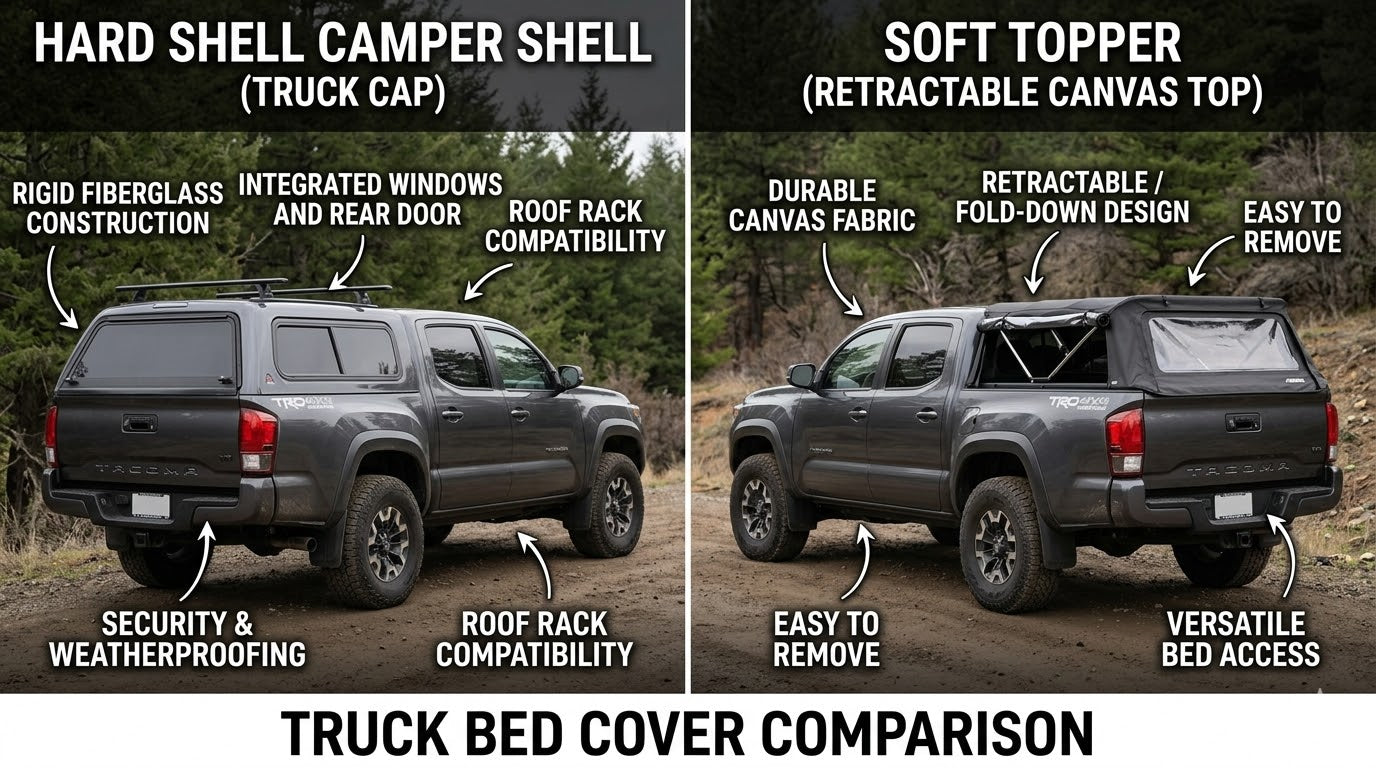
Quick Answer: A hard truck cap is a rigid enclosure (fiberglass, aluminum, or stainless steel) that provides maximum weather protection, security, and roof rack compatibility — but weighs 150–350 lbs, costs $1,800–$5,500+, and requires multiple people to remove. A soft topper is a lightweight canvas or fabric shell (30–60 lbs) that costs $900–$1,500, removes in under 60 seconds by one person, but cannot support roof racks and offers limited security. Choose a hard cap for overlanding builds, tool security, and roof top tent mounting. Choose a soft topper for occasional weather protection, dual-purpose trucks, and budget builds.
This is the decision that holds up more truck owners than any other camper shell question: do you go hard or soft? A hard truck cap and a soft topper both cover your bed. They both keep rain off your gear. They both create enclosed cargo space. But the similarities end there. The two products are built from completely different materials, install and remove in completely different ways, support completely different accessories, and serve completely different types of truck owners.
We sell both at Off Road Tents — hard caps from ARE, RSI SmartCap, GAIA Campers, OVS, and Alu-Cab alongside soft toppers from Softopper and Fas-Top. We've helped thousands of customers make this choice, and the right answer always comes down to how you actually use your truck. This guide compares the two options across every factor that matters so you can make the call with confidence.
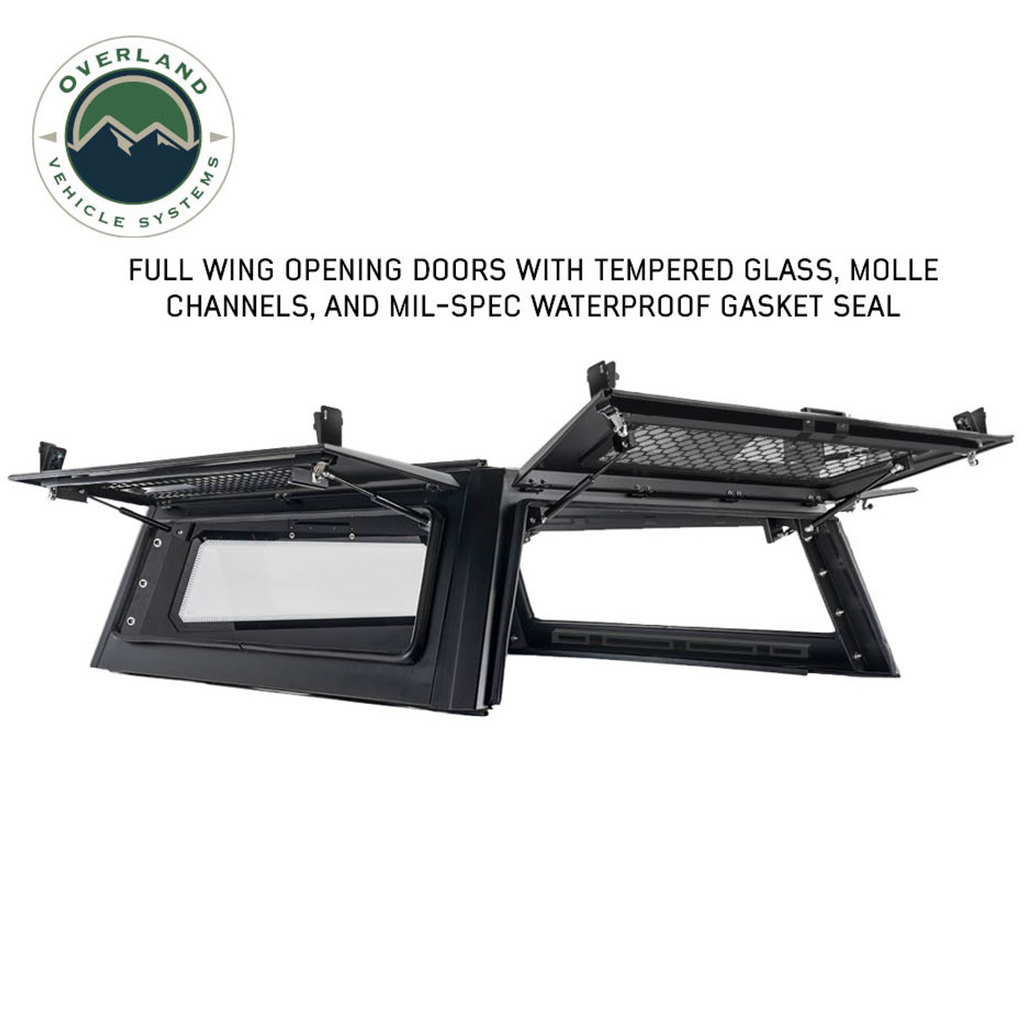
Hard truck cap — OVS Expedition stainless steel with gullwing doors

Soft topper — Softopper waterproof canvas on aluminum frame
Hard Truck Cap vs Soft Topper: Side-by-Side Comparison
| Factor | Hard Truck Cap | Soft Topper |
|---|---|---|
| Materials | Fiberglass, aluminum, or stainless steel | Waterproof canvas or heavy-duty fabric on aluminum frame |
| Weight | 150–350 lbs | 30–60 lbs |
| Price Range | $1,800–$5,500+ | $900–$1,500 |
| Weather Protection | Excellent — fully sealed, waterproof | Good — waterproof fabric, but seams can leak over time |
| Security | Strong — locking doors, tempered glass, steel construction | Basic — locking zippers, fabric can be cut |
| Roof Rack Compatible | Yes — most hard caps support crossbars and RTTs | No — frame cannot support roof-mounted loads |
| Removal Time | 30–60 min, requires 2–4 people | Under 60 seconds, one person |
| Payload Impact | Significant — subtracts 150–350 lbs from capacity | Minimal — subtracts only 30–60 lbs |
| Fuel Economy Impact | Slight improvement in aero, offset by weight | Slight improvement in aero, minimal weight penalty |
| Durability | Excellent — steel and aluminum last decades | Moderate — UV degrades canvas over 5–8 years |
| Sleeping Inside | Yes — enclosed, insulated, private | Yes — but less insulation and privacy |
| Best Brands (at ORT) | ARE, RSI SmartCap, GAIA, OVS, Alu-Cab | Softopper, Fas-Top |
When to Choose a Hard Truck Cap
You're Building an Overland Rig
If your truck is an overlanding platform — or becoming one — a hard cap is almost always the right call. Hard caps from RSI SmartCap, GAIA, and OVS support roof racks, crossbars, and roof top tents on top. That means your bed stays enclosed for gear storage while your tent sits above, creating a two-layer system. A soft topper can't do this. It physically cannot support roof-mounted weight. For any build where you plan to mount something on top of the shell, a hard cap is the only option.
Security Is a Priority
A hard truck cap with locking doors, tempered glass windows, and a steel or aluminum body provides real security. We're not talking padlock-on-a-toolbox security — we're talking break-in-deterrent security. The RSI SmartCap features welded stainless steel doors with MOLLE panels inside. The OVS Expedition includes locking paddle latches on every access point. GAIA shells have welded steel bars behind the window glass. A thief with a knife can get through a soft topper in seconds. Getting through a locked stainless steel cap requires real tools, noise, and time. If you leave expensive tools, camera equipment, firearms, or recovery gear in your truck overnight, a hard cap is the only responsible choice.
You Want Maximum Weather Protection
Hard caps seal tighter and last longer in harsh conditions. Fiberglass and steel don't degrade from UV. Rubber gaskets between the cap and the bed rails create a proper weatherproof seal. Rain, snow, dust, and mud stay out consistently over years. Soft toppers use waterproof fabric and sealed seams, which work well initially — but UV exposure, repeated folding, and general wear can degrade the waterproofing over time. In a sustained downpour or dusty washboard road, a hard cap keeps the interior noticeably drier and cleaner than a soft topper.
You Plan to Keep It On Permanently
If you rarely or never need a fully open bed, a hard cap makes more sense financially and functionally. You install it once, and it stays. The gullwing doors on shells like the OVS Expedition and RSI SmartCap give you access to the bed from three sides without removing the cap. The added weight becomes a non-issue because it's a permanent part of the truck's configuration that you can plan your payload around.
When to Choose a Soft Topper
You Switch Between Open and Covered Bed Regularly
This is the soft topper's killer feature. A Softopper folds flat against the truck's bulkhead or removes entirely in under 60 seconds — one person, no tools. Need to haul furniture on Saturday and camp on Sunday? A soft topper switches between both in the time it takes to unlatch a few clips. Removing a hard cap is a 30–60 minute project that requires helpers, a garage, and somewhere to store a 200+ lb shell. If your truck serves double duty between work and play, a soft topper eliminates the hassle of swapping between open and covered bed configurations.
You're on a Budget
Softopper's full-truck models start around $900–$1,100 depending on the vehicle. Fas-Top's Traveler — which converts between a tonneau cover and a topper — runs around $1,400–$1,500. Compare that to hard caps starting at $1,800 for entry-level fiberglass and climbing past $5,000 for premium steel shells. If you need basic weather protection and enclosed bed space without spending $3,000+, a soft topper delivers 80% of the functionality at 30% of the cost.
Payload Matters to You
Every pound your cap weighs is a pound less cargo your truck can carry. A Softopper adds 30–60 lbs. An OVS Expedition adds 250+ lbs. A GAIA stainless steel shell can hit 300+ lbs. On a midsize truck like a Tacoma or Gladiator with 1,200–1,500 lbs of payload capacity, that difference matters. If you regularly haul heavy loads inside the bed — bags of concrete, water jugs for extended trips, a full tool kit — a soft topper preserves significantly more usable payload than a hard cap.
You Only Need Occasional Coverage
If you camp a few weekends a year and just need something to keep rain off your gear during the drive, a soft topper is the right tool. You don't need welded stainless steel and tempered glass to keep a sleeping bag dry for a Friday night trip. A soft topper handles occasional weather protection perfectly, and on the days you don't need it, it's folded flat and out of the way. Hard caps are an investment for permanent use. Soft toppers are a solution for flexible use.
What About the Middle Ground?
A few products blur the line between hard cap and soft topper. The Fas-Top Traveler converts between a flat tonneau cover and a raised topper configuration — giving you a 2-in-1 product that offers more versatility than a standard soft topper while still being lighter and cheaper than a hard cap. It doesn't support roof racks, but it gives you two cover modes in one product.
The GAIA pop-top camper shell takes a different approach from the hard side — it's a full stainless steel base with a pop-up roof section that lifts to create extra headroom and, on some models, integrates a roof top tent. When closed, it looks and functions like a standard hard cap. When opened, it becomes a camp shelter. This is the premium option for overlanders who want a hard shell with built-in camping functionality.

GAIA pop-top camper shell — hard cap base with integrated tent when deployed
How to Decide: The 5-Question Test
Still not sure? Run through these five questions. Your answers will point you in the right direction every time.
Answer each honestly:
1. Will you mount a roof rack or roof top tent on the shell?
→ Yes = Hard cap. Soft toppers can't support roof-mounted loads.
2. Do you need to remove the shell more than once a month?
→ Yes = Soft topper. Hard cap removal is a project, not a task.
3. Do you store expensive items in the bed overnight?
→ Yes = Hard cap. A locking steel shell deters theft. Canvas zippers do not.
4. Is your budget under $1,500?
→ Yes = Soft topper. The cheapest hard caps start around $1,800.
5. Does your truck's payload capacity concern you?
→ Yes = Soft topper. A 30–60 lb canvas shell preserves far more payload than a 200–350 lb hard cap.
If your answers lean toward hard cap on 3 or more questions, go hard. If they lean soft on 3 or more, go soft. If it's split, look at the middle-ground products like Fas-Top or consider starting with a soft topper — you can always upgrade to a hard cap later once you know how you actually use the truck.
Frequently Asked Questions
Can you convert a soft topper into a hard cap later?
Not directly — they're completely different products with different mounting systems. But you can remove a soft topper and install a hard cap on the same truck without any modifications. The bed rails are the same. Many customers start with a Softopper to test whether they like having an enclosed bed, then upgrade to an RSI SmartCap or OVS Expedition once they've committed to the setup. The soft topper becomes a backup or gets sold.
Which lasts longer — a hard cap or a soft topper?
Hard caps last significantly longer. A fiberglass ARE shell or a stainless steel OVS Expedition will last the life of the truck with minimal maintenance. Aluminum shells from Alu-Cab and SmartCap are equally durable. Soft toppers have a finite lifespan — the canvas and vinyl degrade from UV exposure over 5–8 years depending on climate and how often the topper is exposed to direct sun. You may need to replace the fabric or the entire topper in that timeframe. In hot, sunny climates like Arizona or Texas, UV degradation is faster.
Can you sleep in a truck with a soft topper?
Yes. A soft topper creates a covered sleeping space that keeps rain and bugs out. It's more than adequate for weekend camping. However, soft toppers provide less insulation than hard caps (fabric vs steel or fiberglass), offer less sound insulation from outside noise, and don't darken the interior as effectively — morning sun comes through the fabric. If you're a frequent truck bed camper or plan extended overlanding trips, a hard cap creates a more comfortable sleeping environment. For occasional camping, a soft topper works well.
Does a hard cap or soft topper affect fuel economy more?
Both improve aerodynamics over an open bed by smoothing airflow, which can gain you 1–3 MPG at highway speeds. The difference is weight. A soft topper adds 30–60 lbs — negligible. A hard cap adds 150–350 lbs, which offsets some of the aerodynamic benefit. In practice, a soft topper likely provides a slightly better net fuel economy improvement than a heavy hard cap, but the difference between the two is marginal — maybe 0.5–1 MPG. Neither should be chosen based on fuel economy alone.
What's the best hard cap for overlanding?
For maximum durability and modularity, the RSI SmartCap EVO Adventure — modular stainless steel, gullwing doors with MOLLE panels, compatible with drawer systems and kitchen modules. For the best value in a steel cap with strong roof rack capability, the OVS Expedition (750 lb static roof rating, three wing doors, lifetime warranty). For a pop-top design with optional integrated tent, GAIA Campers. For the lightest hard cap that still handles off-road abuse, Alu-Cab Explorer Canopy. See our full camper shell guide for detailed brand comparisons.
What's the best soft topper?
Softopper is the clear market leader for soft truck toppers. They offer vehicle-specific fitments for virtually every truck, weigh 30–60 lbs, install and remove in seconds, and cost under $1,100 for most models. Fas-Top's Traveler is the premium alternative — it converts between a flat tonneau cover and a raised topper, giving you two products in one. At ~$1,400–$1,500, it costs more than Softopper but offers more versatility.
Related Guides
📖 Camper Shell Guide 2026
Complete guide covering all camper shell types, materials, brands, roof rack compatibility, and pricing.
📖 Canopy Roof Racks
Crossbars and platform racks designed to mount on hard truck caps for RTTs, bikes, and cargo.
📖 Shop Hard Truck Caps
Browse ARE, RSI SmartCap, GAIA, OVS, and Alu-Cab hard caps with free shipping.
📖 Shop Soft Toppers
Softopper and Fas-Top soft truck toppers — lightweight, removable, budget-friendly.
Need Help Choosing?
We carry both hard truck caps and soft toppers for every major truck. Tell us your vehicle, your budget, and how you use your truck — we'll recommend the right one.
Shop Camper Shells📞 844-200-3979 | Free Shipping | Expert Fitment Advice