
180 vs 270 Awning: Which One Do You Actually Need?

Quick Answer
A 270 awning (270 degree awning) is a vehicle-mounted, wraparound shade system that provides expansive shelter covering one full side and the rear of the vehicle — typically 80–129 sq. ft. of coverage. A 180 awning (180 degree awning) extends along one side only, covering 60–85 sq. ft. The key difference is rear coverage: a 270 awning wraps around your tailgate area, creating a continuous sheltered space for cooking, lounging, and gear staging without moving the vehicle. A 180 awning does not cover the rear. Choose a 270 degree awning for families, extended overlanding trips, and tailgate kitchen setups. Choose a 180 degree awning for solo or couples camping, lighter rigs, faster setup, and budget builds. Both mount to a roof rack and deploy as free standing awning systems in calm weather conditions.
This is the decision that every overlander hits after they've committed to adding shade to their rig: do you go with a 270 awning that wraps around the side and rear for maximum coverage, or a 180 awning that covers one side for a simpler, lighter, more affordable setup? Both create a sheltered outdoor living space. Both mount to your roof rack. Both protect you from sun, rain, and wind. But they differ in coverage area, weight, cost, setup complexity, and which camping scenarios they handle best.
We sell both at Off Road Tents — the full Overland Vehicle Systems 270 awning and 180 awning lineup, plus 270 and 180 models from Eezi-Awn, Rhino-Rack, Tuff Stuff, 23Zero, GoFSR, and BunduTec. We've helped thousands of customers make this decision, and the right answer depends on your vehicle, your crew size, and how you actually camp. This guide compares 270 vs 180 awnings across every factor that matters.
📞 Can't decide between a 270 and 180? Call us at 844-200-3979. Tell us your vehicle, your rack, your crew size, and your budget — we'll recommend the right one in five minutes.
270 Awning vs 180 Awning: Side-by-Side Comparison
| Factor | 270 Degree Awning | 180 Degree Awning |
|---|---|---|
| Coverage Area | 80–129 sq. ft. (side + rear) | 60–85 sq. ft. (one side only) |
| Coverage Pattern | Wraps side + rear (batwing shape) | Extends one side (rectangular shade) |
| Rear/Tailgate Coverage | Yes — sheltered cooking area at tailgate | No — rear is open |
| Weight | 45–75 lbs | 25–50 lbs |
| Price Range | $595–$1,625+ | $300–$750 |
| Solo Setup Time | 3–5 minutes | 1–3 minutes |
| Free Standing | Yes — most 270s are free standing in calm conditions | Some models — most need poles or guy ropes |
| Wall Options | Full enclosure (2–3 walls + floor available) | Side walls available on most models |
| Wind Resistance | Moderate — larger sail area, needs stakes in wind | Better — smaller profile catches less wind |
| Ideal Crew Size | 3–6+ people | 1–3 people |
| Best For | Families, extended trips, tailgate kitchens | Solo/couples, weekends, light rigs |
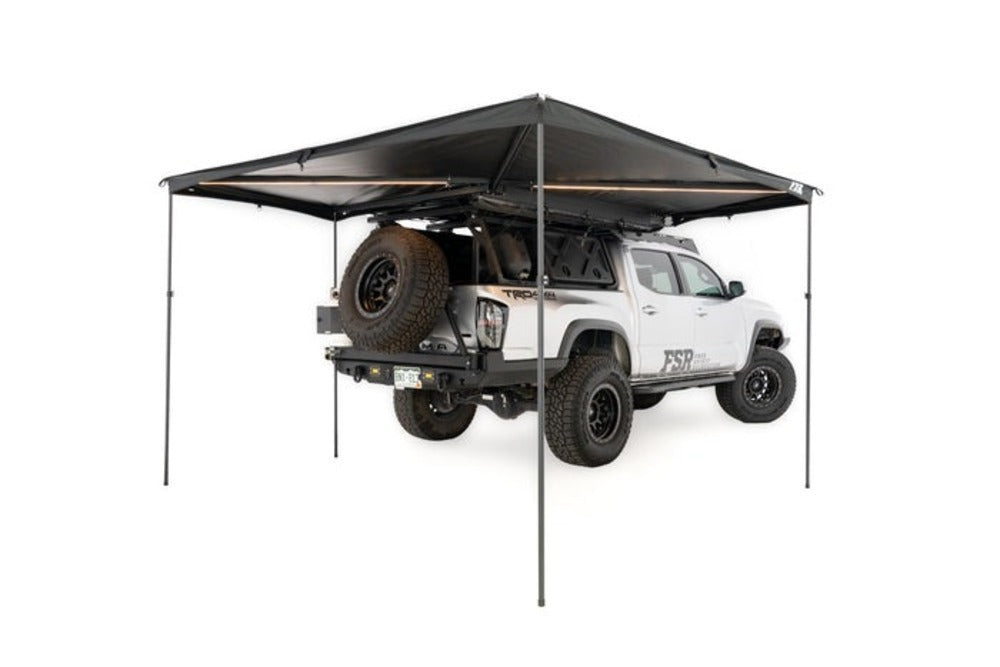
A 270 degree awning wraps around the side and rear — covering the tailgate area that a 180 leaves exposed
What Is a 270 Awning?
A 270 awning is a vehicle-mounted shade system that provides 270 degrees of coverage — wrapping around one full side and the rear of your vehicle in a batwing shape. When deployed, a batwing awning 270 creates a continuous sheltered space from the front of the vehicle's roof line, along the passenger side (or driver's side), and around the rear above the tailgate. This wraparound coverage is what separates a 270 degree awning from every other type of vehicle shade.
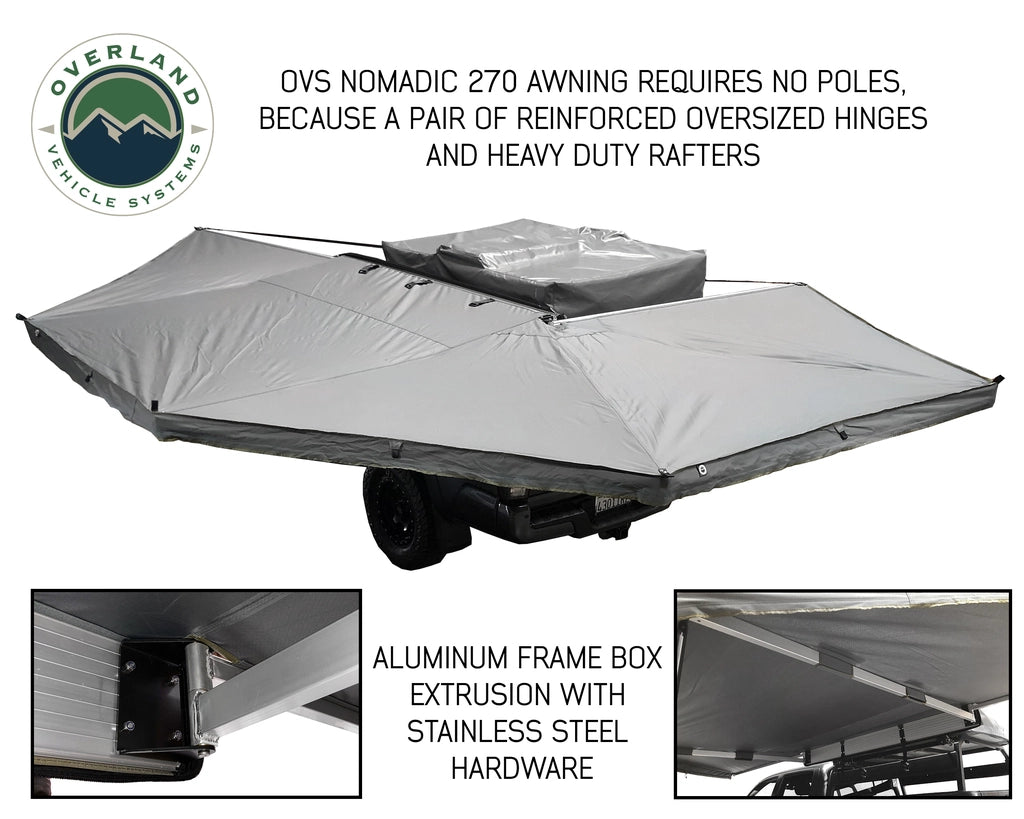
OVS Nomadic 270 — 129 sq. ft. of free standing coverage in a batwing configuration
The construction of a 270 awning typically includes an aluminum frame (often aerospace-grade on premium models) with reinforced truss arms that swing out from a roof-mounted case. Most modern 270 degree awnings are built to be a free standing awning — they support themselves with integrated legs and arms without needing poles in calm weather conditions. In wind, you add guy ropes and stakes for added stability. The fabric is typically 280–600D ripstop polyester or poly-cotton canvas with waterproof and UV-resistant coatings designed to withstand harsh weather conditions across every season.
The rear coverage of a 270 degree awning is the feature that sells it. That wraparound section creates a sheltered cooking area at the tailgate — the most natural kitchen location for truck overlanders. You can cook, eat, and stage gear under continuous shade without repositioning your vehicle. Add optional sidewalls and you transform the awning into a fully enclosed room with wind and rain protection on all sides. Some 270 awning with walls and floor packages create a complete ground-level shelter that functions as additional sleeping space or a bug-proof lounge area.
Best 270 Awning Options We Carry
The OVS Nomadic 270 ($849.99) is the most popular ovs 270 awning and overland vehicle systems 270 awning we sell — 129 sq. ft., freestanding, 600D poly-cotton, four-year warranty. The OVS Nomadic Lite 270 (~$585–$650) provides 80 sq. ft. at a lower weight for midsize rigs. The OVS XD Nomadic 270 adds integrated LED lighting, blackout fabric, and a lifetime frame warranty for overlanders who deploy daily. For premium builds, the Eezi-Awn Bat 270 ($1,625) offers expedition-grade robustness built in South Africa. The GoFSR 270 Awning V2 ($1,250), also known as the fsr 270 awning, is another premium option with robust construction. The Tuff Stuff 270 Compact ($770) delivers 80 sq. ft. at a competitive price point with easy setup.
For the overland 270 awning buyer looking for maximum coverage with walls, the OVS Nomadic 270 with Side Walls (~$1,550) includes three wall panels that zip on for full enclosure. The OVS Nomadic Lite 270 with Walls (~$1,018–$1,050) offers the same enclosed shelter concept at a lighter weight and lower price. The Rhino-Rack Batwing 270 (~$913) is a strong mid-premium option that integrates cleanly with Rhino-Rack crossbar systems.
Note on the iKamper Exoshell 270 Awning: The ikamper exoshell 270 awning is a newer entry in the 270 awning market from a brand best known for roof top tents. It features a hard-case design that integrates with iKamper's tent ecosystem. We don't currently carry it, but if you're considering it, call us and we can help you compare it against the OVS and Eezi-Awn options we do stock.
What Is a 180 Awning?
A 180 awning extends along one full side of your vehicle, creating a wide rectangular shade area perpendicular to the vehicle's roof line. Unlike the wraparound batwing shape of a 270, a 180 degree awning covers one side only — no rear tailgate coverage. The 180 awning swings to the front or the back from its mounted position, giving you flexibility in where you direct the shade based on sun angle and camp layout.

OVS HD Nomadic 180 LTE — 75 sq. ft. of side coverage at $449.99
A 180 degree awning is lighter, simpler, and faster to set up than a 270. Most weigh 25–50 lbs versus 45–75 lbs for a 270. Setup takes 1–3 minutes solo versus 3–5 for a 270. They cost roughly half what a comparable 270 costs. For solo travelers and couples who need shade for a camp chair, a small table, and a cooking area — without the weight, complexity, and price of a full batwing — a 180 awning is the practical choice.
Some 180-degree awnings are designed to be free standing in calm conditions using integrated arms, while others require telescoping poles and guy ropes for stability. A 180 awning free standing capability depends on the brand and model — not all are self-supporting like a batwing awning 180 or 270 design. The OVS HD Nomadic 180 LTE, for example, uses hinged aluminum arms that provide some self-support, but poles are recommended for secure deployment. Whether you call it an overland awning 180 or a car side awning, adding a 180 awning with walls converts the open shade into an enclosed shelter — zip-on side walls block wind, rain, and provide privacy. A 180 degree awning with walls is a practical shelter solution for overlanders who don't need the full wraparound coverage of a 270 but still want the option to close off their camp space from the elements.
Best 180 Awning Options We Carry
The OVS HD Nomadic 180 LTE ($449.99) is our top-selling ovs 180 awning and the go-to ovs 180 lte awning for overlanders on a budget. It provides approximately 75 sq. ft. of shade with an aluminum frame, heavy-duty fabric, and a four-year limited warranty. The nomadic awning 180 mounts to any aftermarket roof rack with included hardware. For the best 180 awning under $600, it's hard to beat.
The 23Zero Peregrine 180 Compact 2.0 ($549) is a quick-deploy option with oversized hinges designed for easy setup. The Eezi-Awn Swift Awning ($740) is the premium 180-degree pick, built with Eezi-Awn's signature South African durability. For Toyota 4Runner owners looking for a 180 awning 4Runner setup, the ovs nomadic awning 180 LTE and Rhino-Rack 180 options both mount cleanly on popular 4Runner roof rack systems from Prinsu, Front Runner, and Eezi-Awn K9. The Alu-Cab Shadow Awning — the alu cab 180 awning — is known for strength and quick deployment, built by the same South African manufacturer behind the Alu-Cab camper shell line. For a 180 car awning on a compact SUV or crossover, the lightweight OVS 180 LTE is the best choice — it delivers solid shade without overwhelming your vehicle's payload. It's the best 180 degree awning for lighter rigs that can't handle a full batwing setup.
The Real Differences That Matter on the Trail
The comparison table covers the specs. But specs don't tell you what it's actually like to camp under each one. Here's what the numbers don't capture.
Coverage & Camp Layout
A 270 awning fundamentally changes how you use the space around your vehicle. The continuous sheltered space from side to rear means your kitchen, dining area, and gear staging all happen under one roof. You don't reposition the vehicle when the sun moves — the 270's wraparound coverage handles sun from almost any angle. The rear coverage is particularly valuable for truck overlanders who cook at the tailgate. With a 270, your entire camp workflow — cooking, eating, packing, unpacking — happens under shade without stepping into sun or rain.
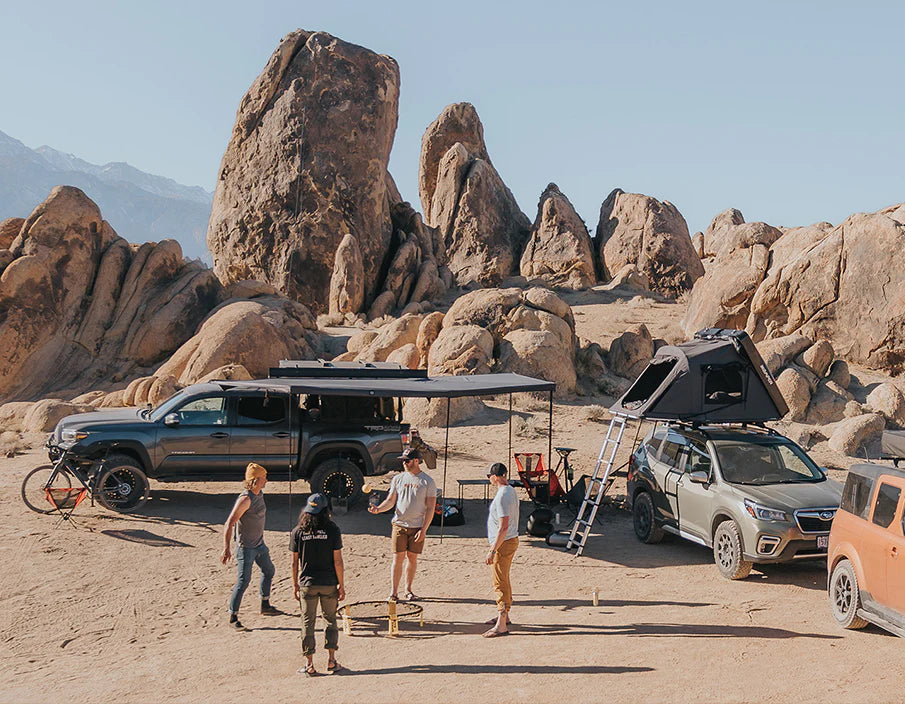
Under a 270 awning — the wraparound coverage creates room for a full outdoor living space
A 180 awning creates a dedicated side zone. It's a shelter that covers your chairs, your stove, and your immediate camp area along one side of the vehicle. It's adequate shade for most situations. But when the sun swings behind the vehicle or rain comes from the rear, you're exposed. If you cook at the tailgate, the 180 doesn't protect that area. For many solo travelers and couples, this is a perfectly acceptable tradeoff — they don't need wraparound coverage for a two-chair camp. But families and groups notice the difference immediately.
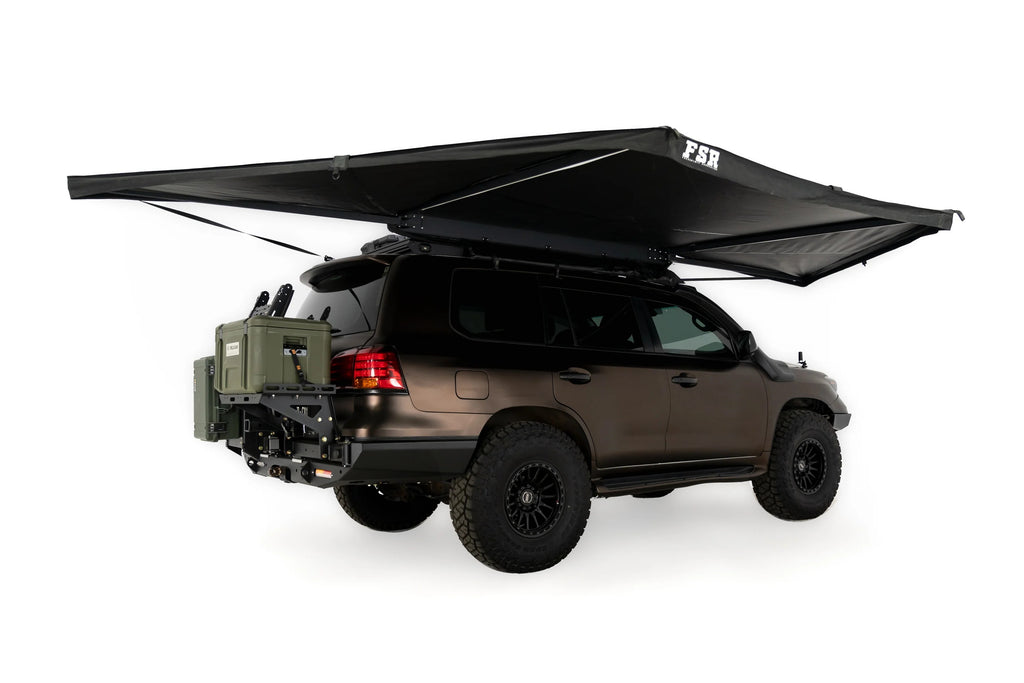
A 180 awning covers one side only — the rear and tailgate remain exposed
Weight & Vehicle Impact
This is where the 180 awning wins cleanly. At 25–50 lbs versus 45–75 lbs for a 270, the weight difference is significant for lightweight vehicles, midsize trucks, and rigs that are already near payload limits. A 270 awning adds 45–75 lbs to one side of your roof rack, raising the center of gravity and creating an asymmetric load. On technical off-road sections, steep descents, and high-speed highway legs, you'll notice it — especially on lifted rigs with a high center of gravity. A 180 awning adds less weight, creates less drag at highway speeds, and has less impact on fuel economy. For SUVs, crossovers, and anyone who counts payload pounds carefully, the 180 is the lighter, safer choice.
Setup & Teardown
Both can be deployed by one person, but the 180 is faster. Most 180 degree awnings deploy in 1–3 minutes: unlatch, swing out, extend legs, done. A 270 degree awning takes 3–5 minutes solo because you're deploying two hinged arms that need to swing into position, lock, and extend legs on both the side and rear sections. In calm conditions, neither is difficult. In wind, the 270's larger sail area makes deployment trickier — you're wrestling more fabric. Teardown follows the same pattern: 180 packs faster, 270 takes more steps. Over a two-week trip where you set up and tear down daily, the difference adds up to hours of total time.
Wind Performance

Reinforced aluminum arms and secure mounting brackets are critical for wind stability
A 180 awning catches less wind because it has less fabric and a simpler profile. In moderate wind (15–20 mph), a staked 180 holds up well. A 270 degree awning has significantly more surface area — it's essentially a sail wrapped around your vehicle. The OVS Nomadic 270 is rated to withstand 25 mph free standing and 40 mph when fully staked with guy ropes, but that large area still creates more stress on mounting brackets and the rack during gusts. In exposed, windy camp locations (desert flats, mountain ridges, coastal sites), a 180 is the safer option. Both should be retracted in severe storms and high winds to prevent damage to the frame, fabric, and your vehicle's roof rack.
Price & Value
The cost difference is substantial. A quality 180 awning runs $300–$750. A quality 270 awning runs $595–$1,625+. Add optional walls and the gap widens further — a 270 awning with walls from OVS costs ~$1,550, while a 180 awning with walls is typically $500–$900 total. If you're on a budget or building your first overland rig, the 180 gets you quality shade at roughly half the investment. If you camp frequently, run a family rig, or consider the awning a core part of your outdoor experience, the 270's extra coverage justifies the premium. You can also start with a 180 and upgrade to a 270 later — the mounting brackets are often compatible, so you're not wasting money on hardware.
When to Choose a 270 Awning
You camp with a crew of 3 or more. The 100–129 sq. ft. of coverage on a full-size overland awning 270 provides room for multiple chairs, a table, a cooking area, and gear staging. A 180 gets crowded fast with more than two people.
You cook at your tailgate. The rear coverage of a 270 degree awning is designed to shelter your tailgate kitchen from sun and rain. If your camp kitchen lives at the back of your truck, the 270 is the only awning type that protects it.
You take extended trips (7+ days). On longer adventures, the extra living space under a 270 pays dividends every day. You spend more time under your awning on a multi-week trip than in any other part of your camp. The comfort upgrade from 75 sq. ft. to 129 sq. ft. compounds across weeks.
You want enclosed shelter capability. If you plan to add a 270 awning with walls — or eventually a 270 awning with walls and floor for a fully enclosed room — starting with a 270 gives you a modular foundation that expands over time. No 180 can match the enclosed space a walled 270 creates.

A 270 awning with walls and annex creates a fully enclosed room — additional sleeping or living space at camp
When to Choose a 180 Awning
You camp solo or as a couple. Two people don't need 129 sq. ft. of shade. The best 180 awning options provide 60–85 sq. ft. — plenty for two chairs, a stove, and a table. You save weight, money, and setup time.
Your vehicle is lightweight or near payload limits. A 180 awning saves 20–30 lbs compared to a 270. On midsize trucks (Tacoma, Ranger, Colorado), compact SUVs (Outback, RAV4), and crossovers, that weight difference matters for handling and payload math. A 180 car awning on a lighter vehicle is the practical, safe choice.
You prefer fast setup and teardown. If you stop frequently on a driving-heavy trip — quick lunch stops, short rest periods, overnight pullouts — a 180 deploys and packs in half the time of a 270. Speed matters when you're setting up in fading light or breaking camp in rain.
You're on a budget. A quality ovs 180 awning at $449.99 costs roughly half what the equivalent OVS 270 costs at $849.99. The saved $400 buys camp chairs, a cooking setup, or a portable power station that improves your camping experience in other ways. The best 180 degree awning is the one that fits your budget while still providing reliable shade and rain protection.
A 180 awning may be more suitable for vehicles with a tailgate that lifts up (SUVs, wagons, hatchbacks). A 270's rear section can interfere with an upward-opening hatch, while a 180 stays clear of the rear entirely.
Can You Use Both? Dual-Awning Setups

An awning and roof top tent running on the same rack — plan mounting positions to avoid interference
Some overlanders run a 180 awning on the passenger side and a small straight-pull side awning on the driver's side — creating coverage on both sides without the weight and cost of a 270. This is a less common configuration but works well on full-size trucks with high payload capacity and long roof racks. The tradeoff: two mounting points, two cases on the roof, and more setup time than a single 270. For most people, one well-chosen awning is better than two compromises.
Frequently Asked Questions
Is a 270 awning worth the extra money over a 180?
For families, frequent campers, and overlanders who cook at the tailgate — yes, absolutely. The rear coverage, larger shade area, and enclosed-room capability justify the price premium. For solo travelers and weekenders who camp a few times a year, a 180 delivers 80% of the value at half the cost. The best 270 awning is a worthwhile investment if you'll use that extra coverage regularly. If you won't, the money is better spent elsewhere in your build.
Can one person set up a 270 awning?
Yes. Modern 270 degree awnings from OVS, Tuff Stuff, and Rhino-Rack are designed for solo deployment in 3–5 minutes. The arms swing out, the legs extend, and the fabric tensions itself. In calm conditions, it's straightforward. In wind, a second person makes deployment significantly easier — one holds the fabric while the other secures the arms and legs. Practice your first deployment at home, not at a remote campsite in fading light.
Are 270 awnings free standing?
Most modern 270 awnings are a free standing awning in calm weather conditions — they support themselves with integrated arms and legs without needing poles or stakes. The OVS Nomadic 270 is free standing up to 25 mph winds. Above that, you need guy ropes and stakes for added stability. Some budget 270 models require poles in all conditions. Check the manufacturer's specs before assuming any 270 awning free standing capability — the more robust the frame and the reinforced aluminum truss arms, the more likely it holds up without support.
Can I add walls to both 270 and 180 awnings?
Yes. Most quality 270 and 180 awnings accept zip-on or clip-on side walls. OVS sells individual walls for the Nomadic 270 (~$200 each) and wall sets for the Nomadic 180 LTE. A 270 awning with walls creates a larger enclosed space (often room-sized) than a 180 awning with walls. For full enclosure with floor, some 270 models offer a complete 270 awning with walls and floor package that creates a ground-level shelter suitable for sleeping or protected lounging.
Which is better for a 4Runner — a 270 or 180?
Both work well on a 4Runner. For a 180 awning 4Runner setup, the OVS HD Nomadic 180 LTE ($449.99) is the most popular choice — it mounts cleanly on Prinsu, Front Runner, and Eezi-Awn K9 racks and keeps weight reasonable. For maximum shade, an overland awning 270 like the OVS Nomadic Lite 270 (~$585–$650) provides 80 sq. ft. without overwhelming the 4Runner's payload. If you run a roof top tent on the same rack, plan your mounting carefully — the awning should deploy on the opposite side from the tent opening.
What mounting hardware do I need?
Most 270 and 180 awnings ship with universal mounting brackets that work with slotted platform racks and standard crossbars. For specific rack systems, you may need custom brackets or L bracket adapters. OVS awnings include brackets for both driver-side and passenger side mounting. The Eezi-Awn and Rhino-Rack awnings use their own proprietary mounting systems. Front Runner Easy-Out Awning Brackets (~$97) are a popular universal option. Confirm your rack compatibility before purchasing — mounting hardware that doesn't match your rack creates an unsafe install.
Do 270 awnings have LED lighting?
Some do. The OVS XD Nomadic 270 includes integrated LED lighting on three support rafters — ambient light for cooking and camp activities after sunset. The CVT 270 Degree Awning also includes a built-in LED light strip. Standard OVS Nomadic 270 models don't include LEDs, but aftermarket LED strips can be added to any awning for under $50. High-end 270 degree awning models increasingly feature integrated LED lights as a standard feature.
How durable are 270 awnings in harsh weather?
Quality 270 degree awnings are built to withstand harsh weather conditions — rain, UV, moderate wind, and dust. The typical material includes heavy-duty fabrics like 600D ripstop polyester with waterproof PU coatings. Aluminum frames resist corrosion. A well-maintained premium awning — whether 270 or 180 — typically lasts 5–10 years of regular overlanding use. However, no awning is storm-proof. Retract any awning in severe wind (30+ mph unguided) to prevent frame damage. 270 awnings typically block up to 95% of light and 85% of UV rays, providing reliable rain protection and sun shade across every season with proper care. Durability depends on maintenance — always dry the fabric before long-term storage and lubricate hinge points periodically to prevent wear.
Related Guides
📖 Complete Car Awning Guide
Types, materials, mounting, sizing, and every awning we carry — the full guide.
📖 How to Mount an Awning
Step-by-step installation for crossbars, platform racks, and rain gutters.
📖 Shop 270 Awnings
OVS, Eezi-Awn, Rhino-Rack, Tuff Stuff, GoFSR, BunduTec — free shipping on every 270.
📖 Shop All Awnings
Side pulls, 180s, and 270s for trucks, SUVs, Jeeps, and vans — all with free shipping.
Find Your Perfect Awning
We carry 270 and 180 awnings from every major overlanding brand. Tell us your rig and your crew size — we'll match the right one.
📞 844-200-3979 | Free Shipping | Expert Fitment Advice