
Roof Rack Weight Limit Explained: Dynamic vs Static Load 2026

Not all roof racks are created equal when it comes to weight capacity. Understanding how much weight different roof rack brands can actually hold—and what makes some racks stronger than others—is critical for safety and getting the right setup. This guide compares roof rack weight capacity ratings across major brands, explains dynamic vs static load limits, and shows you what to look for when choosing a rack for your vehicle.
🔍 Quick Roof Rack Weight Capacity Comparison
Popular platform rack brands and their weight ratings:
| Roof Rack Brand | Dynamic | Static | Weight |
|---|---|---|---|
| Prinsu Original | 500-600 lbs | 1,000 lbs | 38-85 lbs |
| Prinsu Pro | 600-700 lbs | 1,200 lbs | 40-90 lbs |
| Sherpa Equipment | 150 lbs dynamic | 400 lbs static | 35-80 lbs |
| Rhino Rack Backbone | 370 lbs | 660 lbs | 55-75 lbs |
| Front Runner Slimline II | 330-440 lbs | 660-880 lbs | 80-120 lbs |
Important: Your vehicle's roof capacity may be lower than the rack's rating. Always use the lower number.
📋 What You'll Learn in This Guide
- → Dynamic vs Static Load Ratings Explained
- → Roof Rack Weight Capacity by Brand
- → What Makes Roof Racks Stronger
- → Aluminum Alloys & Material Differences
- → Design Features That Affect Capacity
- → How to Choose Based on Weight Needs
- → How Roof Racks Are Tested
- → Real-World Weight Capacity Performance
- → Frequently Asked Questions
Understanding Roof Rack Weight Ratings: Dynamic vs Static
Before comparing brands, you need to understand how roof rack manufacturers rate their products. Every quality roof rack lists two separate weight capacities.
Dynamic Load Capacity (Driving Weight Limit)
Dynamic load capacity is the maximum weight the roof rack can safely support while your vehicle is in motion. This rating accounts for:
- Wind resistance and aerodynamic forces at highway speeds
- G-forces from braking, acceleration, and cornering
- Vertical impacts from bumps, potholes, and road imperfections
- Vibration and resonance over long distances
- Off-road articulation and extreme lateral forces
For example, the Prinsu Pro platform rack is rated for 600-700 lbs dynamic capacity. This means the rack structure itself can handle that weight while driving—but remember, your vehicle's roof may have a lower limit.
⚠️ Critical Point: The rack's dynamic rating is what the rack structure can handle. Your vehicle's roof might only support 100-165 lbs. Always check both ratings and use the lower number.
Static Load Capacity (Parked Weight Limit)
Static load capacity is the maximum weight the roof rack can support when your vehicle is stationary and parked on level ground. This rating is significantly higher because none of the motion-related forces apply.
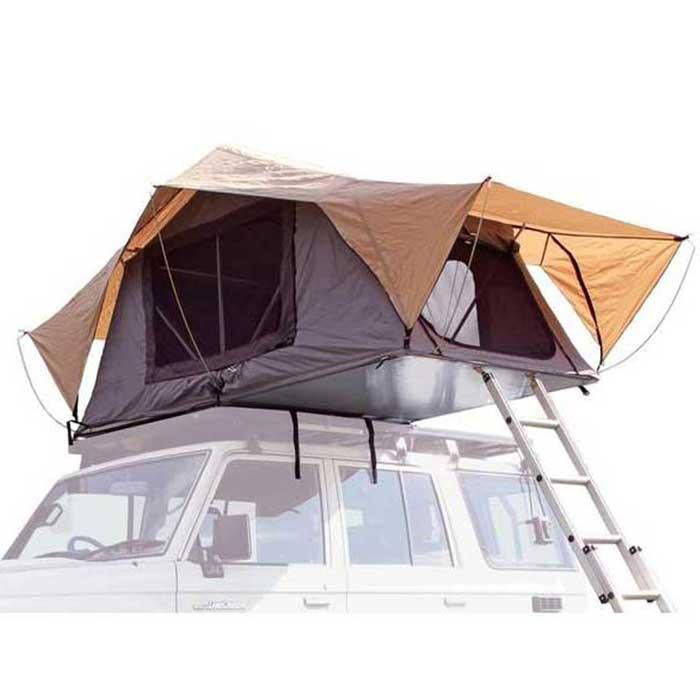
Static capacity is why you can sleep in a roof top tent. A Prinsu Original rack with 1,000 lbs static capacity can support a 150 lb tent plus two adults (350 lbs) for a total of 500 lbs—well within the rack's limits when parked.
Typical static-to-dynamic ratios by brand:
- Prinsu: 2:1 ratio (500 lbs dynamic → 1,000 lbs static)
- Prinsu Pro: 1.7:1 ratio (700 lbs dynamic → 1,200 lbs static)
- Rhino Rack: 1.8:1 ratio (370 lbs dynamic → 660 lbs static)
- Front Runner: 2:1 ratio (440 lbs dynamic → 880 lbs static)
Roof Rack Weight Capacity by Brand: Complete Comparison
Let's compare the actual weight capacity ratings across major roof rack manufacturers. These numbers come directly from manufacturer specifications.
Prinsu Design Studio Roof Racks

Prinsu manufactures two primary rack lines with different weight ratings:
Prinsu Original Series:
- Dynamic capacity: 500-600 lbs (varies by vehicle application)
- Static capacity: 1,000 lbs
- Rack weight: 38.5 lbs (Tacoma cab rack) to 85 lbs (full-length SUV racks)
- Construction: 5052 aluminum plate side rails, 6063 aluminum crossbars
- Best for: Most overlanders needing proven RTT capacity
Prinsu Pro Series:
- Dynamic capacity: 600-700 lbs
- Static capacity: 1,200 lbs
- Rack weight: 40-90 lbs (slightly heavier due to reinforced design)
- Construction: Enhanced dual-layer side rails, 44% stiffer crossbars
- Best for: Heavy-duty applications, larger RTTs, maximum gear hauling
✅ Why Prinsu Racks Have Higher Capacity
Prinsu achieves industry-leading weight ratings through:
- Thicker aluminum: 1/4" (6.35mm) side rails vs 3mm-4mm on competitors
- Reinforced crossbars: 2" x 1" extrusion with dual T-slot channels
- Multiple mounting points: 3-4 attachment points per side vs 2 on some competitors
- Load distribution: Weight spreads across full rack structure
Sherpa Equipment Company Roof Racks
Sherpa Roof Rack Weight Ratings:
- Dynamic capacity: 150 lbs
- Static capacity: 400 lbs
- Rack weight: 35-80 lbs depending on model
- Construction: Aluminum construction with modular design
- Best for: Lighter loads, budget-conscious buyers, modular flexibility
Why Sherpa ratings are lower: Sherpa focuses on lighter, more affordable racks with emphasis on modularity. The trade-off is lower weight capacity compared to Prinsu. However, 150 lbs dynamic is still adequate for many applications including light roof boxes and smaller RTTs when vehicle capacity permits.
💡 Sherpa vs Prinsu Weight Capacity: If you need to haul heavy gear or a large RTT, Prinsu's 500-700 lb dynamic rating gives you significantly more headroom. Sherpa's 150 lb rating works for lighter setups but limits your cargo options. View Sherpa Racks →
Rhino-Rack Systems
Rhino-Rack Backbone Weight Ratings:
- Dynamic capacity: 370 lbs
- Static capacity: 660 lbs
- Rack weight: 55-75 lbs
- Construction: Aluminum platform with integrated Pioneer system
- Best for: Jeep Wrangler and vehicles without roof rails
Rhino-Rack's Backbone system offers mid-tier weight capacity—better than Sherpa, but less than Prinsu. The advantage is the integrated mounting system specifically designed for hardtop vehicles like Jeep Wranglers.
Front Runner Slimline II
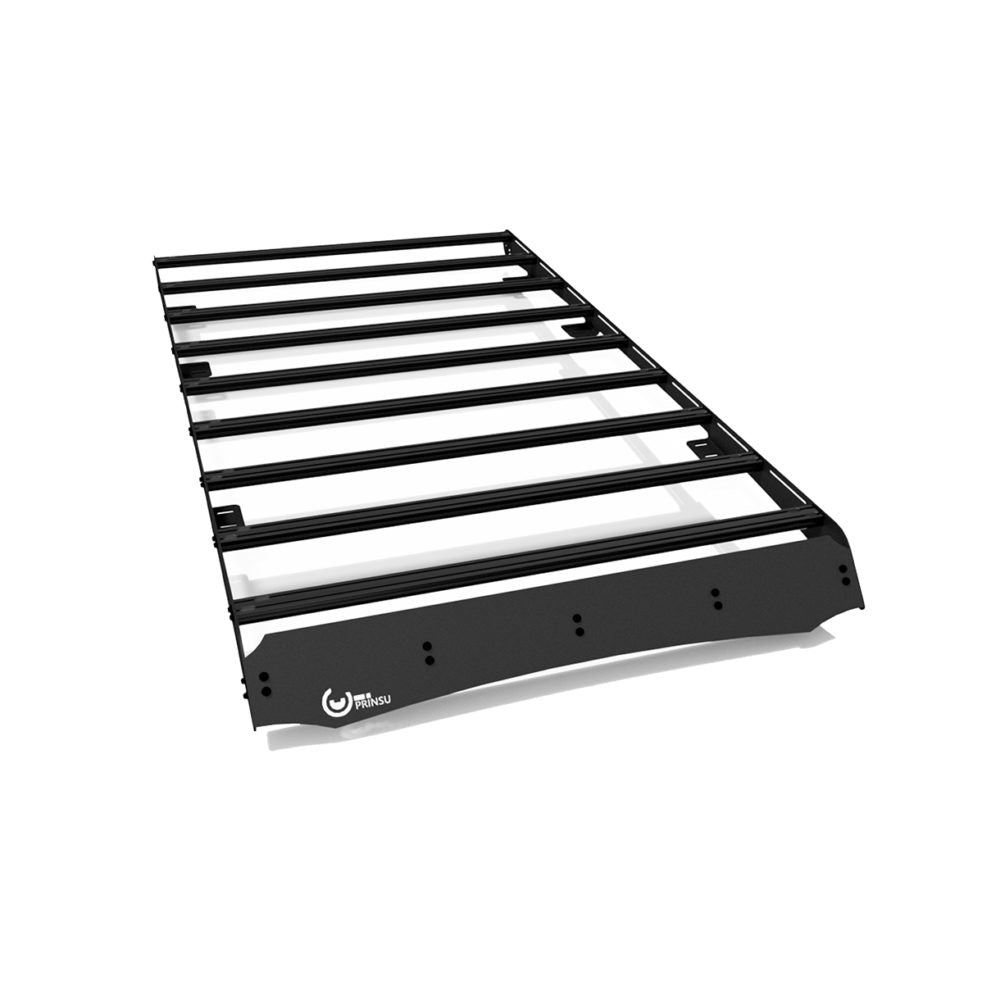
Front Runner Weight Ratings:
- Dynamic capacity: 330-440 lbs (varies by rack size)
- Static capacity: 660-880 lbs
- Rack weight: 80-120 lbs (heavier due to full extrusion design)
- Construction: Full aluminum extrusion slat system
- Best for: Maximum accessory mounting, extensive gear organization
Front Runner racks are heavier but offer excellent weight capacity in the mid-range. The trade-off: the rack itself weighs 80-120 lbs, which eats into your available vehicle roof capacity before you add any cargo.
Thule and Yakima Crossbar Systems
Traditional crossbar systems have lower weight ratings than platform racks:
Thule Crossbars:
- Dynamic capacity: 165-220 lbs (depending on bar type and span)
- Static capacity: Typically 2x dynamic (330-440 lbs)
- Weight: 15-25 lbs per pair
Yakima Crossbars:
- Dynamic capacity: 150-165 lbs
- Static capacity: 300-600 lbs
- Weight: 12-20 lbs per pair
Crossbars work well for lighter cargo but can't match platform rack capacities. They're limited by the two-point contact design vs the distributed load of a full platform.
What Makes Some Roof Racks Stronger Than Others
Weight capacity isn't arbitrary—it's determined by specific design and construction factors. Here's what separates high-capacity racks from lower-rated options.
1. Side Rail Thickness and Material Grade
The side rails are the primary structural element of a platform roof rack. Thicker rails = higher capacity:
Prinsu Original/Pro: 1/4" (6.35mm) 5052 aluminum plate
Sherpa: 3-4mm aluminum
Front Runner: 1.6mm aluminum extrusion (compensated by slat design)
Rhino Rack: 4mm aluminum
Thicker side rails resist flexing under load and distribute weight more effectively across mounting points.
2. Crossbar Design and Strength
Crossbars carry the actual cargo weight. Their design dramatically affects capacity:
Prinsu crossbars: 2" x 1" aluminum extrusion with dual T-slots
Prinsu Pro crossbars: 44% stiffer than original (redesigned geometry)
Front Runner: Multiple 19mm slats distributing load
Thule/Yakima: Aerodynamic hollow bars (lighter but lower capacity)
The Prinsu Pro's 44% stiffness increase comes from optimized extrusion shape—same material, better geometry.
3. Number and Quality of Mounting Points
More mounting points = better load distribution = higher capacity:
- Prinsu: 3-4 mounting tabs per side (6-8 total)
- Front Runner: 4 mounting points per side (8 total)
- Sherpa: 2-3 mounting points per side (4-6 total)
- Crossbars: 2 mounting points total (one per bar)
More mounting points spread the load across your vehicle's roof structure, reducing stress on any single point.
4. Load Distribution Architecture
How the rack transfers weight from cargo to vehicle matters enormously:
Platform racks (Prinsu, Front Runner): Weight spreads across entire platform surface, then down through multiple mounting points. This creates lower stress at any single point.
Crossbar systems (Thule, Yakima): Weight concentrates on two bars, then transfers through two mounting points. Higher stress concentration = lower safe capacity.
Aluminum Alloys and Material Differences
Not all aluminum is created equal. Roof rack manufacturers use different alloys with different strength properties.
5052 Aluminum (Prinsu Side Rails)
Properties:
- High strength-to-weight ratio
- Excellent corrosion resistance (magnesium + chromium content)
- Good formability for laser cutting
- Moderate cost
5052 is the sweet spot for roof rack side rails—strong enough for high capacity, corrosion-resistant for long life.
6063 Aluminum (Crossbars and Extrusions)
Properties:
- Excellent extrusion properties (complex shapes)
- Good strength when properly heat-treated
- Smooth surface finish
- Slightly lower strength than 5052
6063 is ideal for crossbars because it can be extruded into complex shapes (like Prinsu's T-slot design) while maintaining good strength.
Why Powder Coating Matters
All major manufacturers powder coat their racks, but quality varies:
Prinsu: Satin black powder coat with excellent UV resistance
Front Runner: Black powder coat, proven durable
Sherpa: Textured black powder coat
Rhino Rack: Black powder coat finish
Powder coating protects the aluminum from oxidation and corrosion. Quality powder coating lasts 10+ years even in harsh environments (salt, UV, mud).
Design Features That Affect Weight Capacity
Beyond raw materials, specific design choices impact how much weight a rack can safely carry.
Full-Length vs Cab-Only Racks
Longer racks aren't necessarily stronger:
Prinsu Tacoma Cab Rack (38.5 lbs):
Shorter length, same 1,000 lb static capacity as full-length racks. The compact size actually concentrates strength.
Front Runner Full-Length (120 lbs):
Longer span requires more material to maintain rigidity. Heavier but not proportionally stronger.
The lesson: capacity depends on construction quality, not just size.
Modular vs Fixed Design
Modularity affects strength:
Prinsu (modular): Crossbars drop into side rails. Each crossbar adds to overall capacity. Removing bars reduces capacity proportionally.
Front Runner (fixed slats): Welded/riveted construction. Can't remove individual slats. Slightly stronger connections but less flexible.
Both approaches work—it's about preference and use case.
Wind Deflector Integration
Most racks include wind deflectors, but integration varies:
Prinsu: Separate 1/8" aluminum deflector, mounts to front crossbar position. Adds minimal weight, reduces wind noise.
Front Runner: Integrated fairing system. Heavier but very effective for aerodynamics.
Wind deflectors don't significantly impact weight capacity but do add 2-5 lbs to total rack weight.
How to Choose a Roof Rack Based on Weight Capacity Needs
Matching rack capacity to your actual needs ensures safety and avoids overspending.
Calculate Your Actual Weight Requirements
Before choosing a rack, add up what you'll actually carry:
📊 Weight Calculation Worksheet
Roof Top Tent Setup:
Hardshell RTT: 120-140 lbs
Softshell RTT: 150-180 lbs
Two occupants (static): 300-400 lbs
Total static load: 420-580 lbs
Minimum rack needed: 600 lb static capacity
Cargo Box Setup:
Cargo box: 30-50 lbs
Camping gear: 40-60 lbs
Recovery gear: 20-30 lbs
Total dynamic load: 90-140 lbs
Minimum rack needed: 200 lb dynamic capacity (with safety margin)
Heavy Overlanding Setup:
RTT: 150 lbs
Awning: 50 lbs
MaxTrax: 12 lbs
Light bar: 10 lbs
Fuel cans (when driving): 60 lbs
Total dynamic load: 282 lbs
Minimum rack needed: 350+ lb dynamic capacity
Recommended Racks by Use Case
Light Cargo (0-150 lbs total):
- Good choice: Thule/Yakima crossbars (165 lb dynamic)
- Better choice: Sherpa rack (150 lb dynamic, modular)
- Budget: $300-600
Medium Cargo + Lightweight RTT (150-350 lbs total):
- Good choice: Rhino Rack Backbone (370 lb dynamic, 660 lb static)
- Better choice: Prinsu Original (500 lb dynamic, 1,000 lb static)
- Budget: $800-1,400
Heavy Overlanding + RTT (350+ lbs total):
- Best choice: Prinsu Pro (700 lb dynamic, 1,200 lb static)
- Alternative: Front Runner Slimline II (440 lb dynamic, 880 lb static)
- Budget: $1,200-1,800
Don't Forget: Vehicle Roof Capacity Limits
🚨 Critical Reminder: Even if you choose a Prinsu Pro with 700 lb dynamic capacity, your vehicle's roof might only support 100-165 lbs. Check your owner's manual for your vehicle's roof weight limit. Always use the lower number between rack capacity and vehicle capacity.
How Roof Rack Manufacturers Test Weight Capacity
Reputable manufacturers don't just guess at weight ratings—they test extensively.
Static Load Testing
Testing procedure for static capacity:
1. Rack installed on vehicle (or test fixture)
2. Weight added incrementally in 50-100 lb steps
3. Measurement of deflection at each weight level
4. Load held for extended period (typically 30-60 minutes)
5. Inspection for permanent deformation after load removal
The rated static capacity is typically the maximum load the rack sustained without permanent deformation, then reduced by 20-30% safety factor.
Dynamic Load Testing
Dynamic testing is more complex:
1. Simulated road vibration with loaded rack
2. Impact testing (sudden vertical loads)
3. Lateral load testing (cornering forces)
4. Wind tunnel testing for aerodynamic loads (premium brands)
5. Real-world testing on actual vehicles over rough terrain
Prinsu, for example, has tested racks at 200+ lbs dynamic on actual Tacomas and 4Runners on off-road trails without failure. The 500-700 lb rating includes significant safety margin.
Real-World Roof Rack Weight Capacity Performance
💬 What Overlanders Report
"I've had my Prinsu Original on my Tacoma for 3 years carrying a 160 lb RTT plus gear. The rack has zero flex or fatigue. It's rated for 500 lbs dynamic and I'm only at about 200 lbs total, but even on the Rubicon Trail it performed flawlessly."
— Jake M., 2020 Toyota Tacoma, Prinsu Cab Rack
"Upgraded from a Sherpa to a Prinsu Pro specifically for weight capacity. With the Sherpa's 150 lb limit, I was maxed out with just my tent. The Prinsu Pro's 700 lb rating gives me room for my tent, awning, MaxTrax, and jerry cans without worry."
— Sarah P., 2022 Toyota 4Runner, Prinsu Pro Full Rack
"The Front Runner Slimline II is bombproof. I've loaded it with 300+ lbs of gear for month-long trips. The slat design distributes weight perfectly. Only downside is the rack itself weighs 95 lbs, so that eats into my Jeep's 150 lb roof capacity."
— Mike R., 2021 Jeep Wrangler JL, Front Runner Slimline II
Frequently Asked Questions About Roof Rack Weight Capacity
What roof rack has the highest weight capacity?
The Prinsu Pro series has the highest weight capacity among popular overlanding racks: 700 lbs dynamic and 1,200 lbs static. This is achieved through thicker 1/4" aluminum side rails, reinforced crossbars that are 44% stiffer than standard, and a dual-layer construction design.
How much weight can a Prinsu roof rack hold?
Prinsu Original racks: 500-600 lbs dynamic / 1,000 lbs static. Prinsu Pro racks: 600-700 lbs dynamic / 1,200 lbs static. However, your vehicle's roof capacity may be lower (typically 100-165 lbs dynamic). Always use the lower rating between your rack and your vehicle.
Why does my roof rack have a higher weight rating than my vehicle?
Roof rack manufacturers rate what the rack structure itself can support. Your vehicle's roof rating is based on the strength of your roof pillars, mounting points, and overall structure. Even if the rack can hold 700 lbs, your vehicle's roof might only support 150 lbs. The vehicle limit is usually the limiting factor.
What makes Prinsu racks stronger than other brands?
Prinsu uses thicker side rails (1/4" vs 3-4mm on competitors), reinforced crossbar extrusions with dual T-slots, more mounting points (3-4 per side vs 2-3), and higher-grade 5052 aluminum. The Prinsu Pro's crossbars are 44% stiffer than the original design due to optimized extrusion geometry.
Can I exceed a roof rack's weight rating if I'm only parked?
No. The static rating is already higher than dynamic—it's the maximum safe load when parked. Exceeding static capacity risks permanent rack deformation, mounting point failure, and potential roof damage. Always stay within rated capacities with a 20% safety buffer.
How do crossbar systems compare to platform racks for weight capacity?
Platform racks (Prinsu, Front Runner) have much higher capacity: 330-700 lbs dynamic vs crossbars at 150-220 lbs. Platform racks distribute weight across the entire surface and multiple mounting points. Crossbars concentrate weight on two bars and two mounting points, limiting safe capacity.
Do heavier racks have higher weight capacity?
Not necessarily. The Prinsu Cab Rack weighs only 38.5 lbs but has 1,000 lb static capacity. The Front Runner Slimline II weighs 95 lbs with 880 lb static capacity. Weight capacity comes from material thickness, design, and construction quality—not total rack weight.
What's the best roof rack for a heavy roof top tent?
For heavy RTTs (150+ lbs), choose the Prinsu Pro (1,200 lb static) or Prinsu Original (1,000 lb static). These provide ample capacity for the tent plus occupants. Avoid racks under 600 lbs static capacity for heavy RTTs. Shop Prinsu Racks →
How is roof rack weight capacity tested?
Manufacturers test by incrementally loading the rack, measuring deflection, holding loads for 30-60 minutes, and inspecting for permanent deformation. Dynamic testing includes vibration, impact, lateral loads, and real-world trail testing. Rated capacity includes a 20-30% safety factor below failure point.
Should I reduce rack capacity for off-road driving?
Yes. Reduce your dynamic capacity by 33% for serious off-roading. Washboard roads, articulation, and vertical impacts create forces that exceed normal driving. If your rack is rated for 600 lbs dynamic on pavement, treat it as 400 lbs on rough trails.
Final Thoughts: Choosing the Right Rack Capacity
Roof rack weight capacity isn't just a number—it determines what you can safely carry and how confident you can be on any adventure.
The key takeaways:
1. Higher capacity racks cost more but provide safety margin
A Prinsu Pro at $1,400 vs a Sherpa at $800 means 700 vs 150 lbs capacity. That extra $600 buys peace of mind and flexibility.
2. Calculate your actual needs before choosing
Don't guess. Add up tent weight + gear weight + accessory weight. Choose a rack rated at least 50% above your total.
3. Your vehicle's roof is usually the limiting factor
Even with a 700 lb rack, your Tacoma's 100 lb roof limit controls what you can carry while driving.
4. Quality construction matters more than rack weight
The lightest racks (Prinsu at 38.5 lbs) often have the highest capacity due to superior materials and design.
For most overlanders, Prinsu racks offer the best combination of light weight, high capacity, and proven durability. The 1,000-1,200 lb static ratings accommodate any roof top tent plus occupants. The 500-700 lb dynamic ratings provide room for heavy gear loads.
Ready to Choose Your Roof Rack?
We carry the highest-capacity roof racks from Prinsu, Sherpa, Rhino Rack, and more
Questions about roof rack capacity?
Call us at 844-200-3979 or email info@offroadtents.com