
Car Awning 2026
Definition
A car awning (also called a vehicle awning or overlanding awning) is a retractable fabric shelter that mounts directly to a vehicle's roof rack, crossbars, or rain gutter — providing instant shade and weather protection from sun, rain, wind, and snow wherever you park. Vehicle awnings deploy from a compact case bolted to the roof and extend outward on hinged aluminum arms, creating 27–129 sq. ft. of covered outdoor living space in under five minutes. The three main types are straight-pull side awnings (simplest and most affordable), 180-degree awnings (cover one full side of the vehicle), and 270-degree batwing awnings (wrap around one side and the rear for maximum coverage). Car awnings are used in overlanding, car camping, truck camping, tailgating, and general outdoor recreation on SUVs, trucks, vans, and crossovers.
A car awning turns your vehicle into a mobile basecamp. It's the piece of gear that creates the outdoor living space — the covered area where cooking happens, chairs go, gear gets staged, and shade makes the difference between comfortable and miserable on a 95°F afternoon in the desert. Without an awning, you're either sitting inside your vehicle or roasting in direct sun. With one, you've got a sheltered zone that deploys in minutes and packs away just as fast.
We carry vehicle awnings from Overland Vehicle Systems, Eezi-Awn, ARB, Rhino-Rack, Front Runner, 23Zero, Tuff Stuff, BunduTec, and GoFSR at Off Road Tents — everything from budget-friendly $200 car side awning setups to full 270 car awning systems with walls, LED lighting, and enclosed rooms. This guide covers every type of car awning for camping, how they mount, what materials and sizes are available, which one fits your vehicle, and what to expect at each price point. Whether you're looking for an awning for a car you use on weekends, a roof awning car setup for your daily driver, or a dedicated overlanding awning for your expedition rig, this is everything you need to know before you buy.
📞 Not sure which awning fits your rig? Call us at 844-200-3979. Tell us your vehicle, your roof rack, and how you plan to camp — we'll match the right awning for your setup.
📋 Quick Navigation
Types of Vehicle Awnings
There are three main types of car awning, and the one you choose determines your coverage area, setup complexity, weight, and price. Understanding the differences is the most important step before you buy.
Straight-Pull Side Awning (Pull-Out Awning)
A straight-pull car side awning is the simplest, lightest, and most affordable vehicle awning design. It mounts to one side of your roof rack in a compact case and pulls straight out on telescoping aluminum legs, creating a rectangular shade area along the side of your vehicle. Coverage ranges from 27 sq. ft. (4.5' × 6') to 69 sq. ft. (8' × 8.5') depending on the model. Setup takes under two minutes — most can be deployed by one person. This is the best car awning for beginners, budget builds, and anyone who wants a camping awning for car use without the weight and complexity of a batwing system. Whether you call it a retractable car awning or a car awning retractable setup, the concept is the same — a compact shelter that extends from a case on your rack and retracts when you're done.
Popular straight-pull options we carry include the OVS HD Nomadic 90° ($159.99), Tuff Stuff 6.5' × 8' Side Awning (~$310), Tuff Stuff 4.5' × 6' (~$280), Front Runner Easy-Out Awning, and the Eezi-Awn Series 1000 ($645). ARB's Touring Awning also falls in this category, featuring an integrated LED light strip for night use.
180-Degree Awning
A 180-degree awning covers one full side of your vehicle using a wider panel that extends further from the roof line than a standard straight-pull. Think of it as a car roof awning that reaches outward at a wider angle, creating more usable shade under a single canopy without the wraparound coverage of a 270. The Overland Vehicle Systems HD Nomadic 180 LTE ($449.99) is our most popular model in this category — it provides approximately 75 sq. ft. of shade with a durable aluminum frame, heavy-duty fabric, and easy one-person deployment. The 23Zero Peregrine 180 Compact 2.0 ($549) is another strong option with quick-deploy hinges. These awnings work as a car tent awning when paired with optional walls — zip down the sides and you've got an enclosed shelter.
270-Degree Batwing Awning
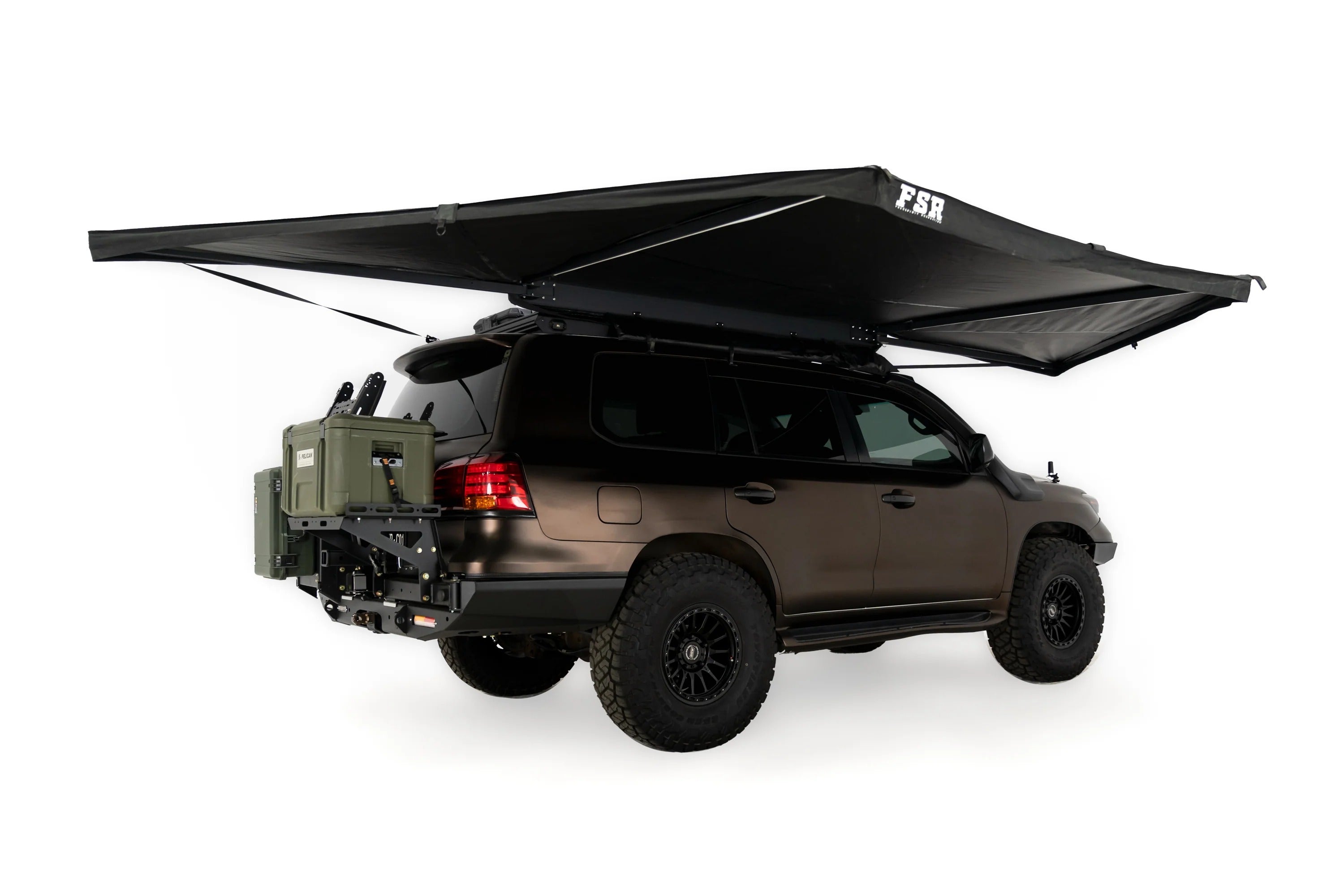
The 270 degree awning is the king of vehicle shade. A 270 awning wraps around one full side and the rear of your vehicle, creating a massive covered area of 80–129 sq. ft. in a single deployment. When you search for the best 270 awning, you're looking at a batwing design that unfolds from a roof-mounted case on hinged aluminum arms — no poles required in calm conditions, though most include adjustable telescoping legs for wind or uneven ground. A 270 car awning transforms the entire driver or passenger side of your rig into an outdoor living space: kitchen under one wing, chairs and table under the other, with the rear section covering the tailgate or hatch area.
This is the overlanding awning that serious overlanders, families, and extended-trip travelers choose when maximum protection from sun rain and wind matters more than saving a few pounds. A quality 270 degree awning weighs 45–75 lbs, costs $600–$1,600+, and takes 3–5 minutes to deploy solo. The tradeoff for that extra shade and coverage is weight, cost, and pack size — but once you've camped under a full 270, it's hard to go back to a simple side pull.
We carry the full range: the Overland Vehicle Systems Nomadic 270 ($849.99 without walls, ~$1,550 with walls), OVS Nomadic Lite 270 (~$585–$650 without walls, ~$1,018–$1,050 with walls), OVS XD Nomadic 270 (125 sq. ft., integrated LED lighting, lifetime frame warranty), Tuff Stuff 270 Compact ($770, 80 sq. ft.), Rhino-Rack Batwing 270 (~$913), Eezi-Awn Bat 270 ($1,625), GoFSR 270 V2 ($1,250), and the BunduAwn by BunduTec ($1,590–$2,170).
| Type | Coverage | Weight | Price Range | Setup Time | Best For |
|---|---|---|---|---|---|
| Straight-Pull Side | 27–69 sq. ft. | 20–40 lbs | $200–$700 | 1–2 min | Budget builds, solo, small vehicles |
| 180-Degree | 60–85 sq. ft. | 35–55 lbs | $450–$750 | 2–4 min | Couples, weekenders, mid-size rigs |
| 270-Degree Batwing | 80–129 sq. ft. | 45–75 lbs | $600–$1,600+ | 3–5 min | Families, overlanders, extended trips |
Materials, Construction & Durability
The quality of a vehicle awning comes down to two things: the fabric and the frame. Cheap versions of both exist, and they fail in exactly the conditions where you need an awning most — high wind, heavy rain, and relentless UV.
Fabric
Most quality car awnings use one of two fabric types. Ripstop polyester (280–420D) is lighter, dries faster, and costs less. It's coated with polyurethane (PU) for waterproofing and treated for UV resistance. This is what you'll find on most budget and mid-tier options like the Tuff Stuff and Guana Equipment awnings. Poly-cotton canvas (typically 600D) is heavier but breathes better in hot conditions, reduces condensation drip, and handles UV exposure over more seasons. The Overland Vehicle Systems awning lineup uses poly-cotton across their Nomadic series, and it's the material of choice for tough, long-lasting overlanding awnings designed to survive years of trail use.
Look for a PU coating rated to at least 2,000mm water column for reliable rain protection. Anything below that risks leaking in sustained downpours. Double-stitched seams and taped seam lines prevent water wicking through needle holes — a detail cheap awnings skip.
Frame
Aluminum frames dominate the vehicle awning market for good reason — they resist corrosion, flex without permanent deformation, and weigh significantly less than steel. Aerospace-grade aluminum (used in the OVS XD Nomadic 270) represents the top end of frame durability. Standard extruded aluminum (found in most mid-tier options) performs well for years. Steel frames are rare in quality car awnings — avoid them unless the price is unbeatable, because they rust and add unnecessary weight.
The hinge points where the arms connect to the case are the most failure-prone parts of any retractable vehicle awning. Oversized hinges with reinforced gussets (like those on OVS and Eezi-Awn models) resist sagging over hundreds of deployments. Budget awnings often use smaller hinges that develop play after 50–100 cycles. If you plan to deploy your awning daily on a multi-week trip, invest in a frame with quality hinges.
How to Mount a Car Awning
Your awning for car use is only as strong as the mounting system that holds it to your vehicle. Poor mounting is the #1 cause of awning failure in the field — not bad fabric, not weak frames, but bolts that weren't tight enough or brackets that weren't designed for the rack you own.
Rack Compatibility
Most vehicle awnings mount to aftermarket roof racks using universal brackets, T-slot channels, or dedicated awning mount kits. Before you buy, confirm that your awning brackets work with your specific rack system. Slotted platform racks (Front Runner Slimline II, Prinsu, Eezi-Awn K9) accept most awning mount kits through their T-slot channels. Standard crossbars (Thule, Yakima, Rhino-Rack) work with clamp-on brackets. Factory roof rails may need adapters. The Front Runner Easy-Out Awning Brackets (~$97) are a popular universal solution for connecting awnings to different vehicles and racks.
Driver Side vs Passenger Side
Straight-pull and 180-degree awnings can mount on either side of most vehicles. The 270 degree awning is often side-specific — check before ordering. In the US, the passenger side is the most popular mounting position because it keeps your camp area away from traffic when you're parked roadside or at a pullout. Driver-side mounting works better for builds where the tailgate kitchen is on the left or when the passenger side is blocked by a roof top tent opening. The Overland Vehicle Systems 270 awnings are available in both driver and passenger configurations.
Weight & Mounting Points
A retractable car awning adds 20–75 lbs to one side of your roof rack. Straight-pull car awnings need a minimum of two mounting points. Larger 270-degree batwing awnings need two to three mounting points for stability on rough roads where vibration is constant. Make sure your roof rack's dynamic weight capacity can handle the awning's weight plus any other gear you're mounting (roof top tent, cargo basket, solar panel). If you're running both an awning and a tent on the same rack, verify they don't interfere when the tent opens or the awning deploys.
Sizing Your Car Awning: How Much Shade Do You Actually Need?
Bigger isn't always better. A 129 sq. ft. 270 awning on a Subaru Crosstrek is overkill — it adds weight, eats payload, and creates a sail in crosswinds. A 27 sq. ft. side pull on a Sprinter van leaves a family of four fighting for a sliver of shade. Match your awning for vehicle size, crew size, and trip style.
Quick Coverage Guide:
Solo travelers: 40–60 sq. ft. — a 6.5' × 8' straight-pull or compact 180 provides enough shade for one person, a chair, and a camp stove.
Couples: 60–90 sq. ft. — a full-size 180 or compact 270 covers two chairs, a table, and a cooking area.
Families / Groups: 100–129 sq. ft. — a full-size 270 degree awning provides the extra shade needed for kids, multiple chairs, a kitchen, and gear staging.
Vehicle height also matters. A car awning on a lifted truck or tall van positions the fabric higher off the ground, which means more wind exposure but more headroom. On lower SUVs and crossovers, the awning sits closer to head height, providing better shade angles but less clearance underneath. Telescoping legs on awnings from OVS, Tuff Stuff, and Rhino-Rack let you adjust height to match your vehicle and terrain.
Best Car Awnings by Category
We've organized the best car awning options we carry by use case and budget. Every one of these ships free from Off Road Tents.
Best Budget Camping Awning: OVS HD Nomadic 90° — $159.99
If you want a camping awning for car use without spending $500+, the OVS HD Nomadic 90° is the entry point. It's a compact straight-pull car camping awning that provides enough shade for one or two people with a simple clamp-on mounting setup that fits any aftermarket roof rack. The fabric is heavy-duty ripstop with a waterproof coating, the frame is aluminum, and OVS backs it with a four-year limited warranty. For weekend car camping awning use or testing whether you want a vehicle awning at all, this is the lowest-risk starting point at an unbeatable price.

OVS HD Nomadic 90° — the most affordable car awning in our lineup at $159.99
Best Value Side Awning: Tuff Stuff 6.5' × 8' — ~$310
Tuff Stuff's straight-pull awning is the best car awning under $350. It's a retractable awning for car builds that provides a generous 52 sq. ft. of shade with a durable aluminum frame and quick-deploy telescoping legs. It mounts on virtually any rack or crossbar setup and handles rain well. For truck camping awning use, this is the size that covers a tailgate kitchen and a pair of camp chairs. The smaller 4.5' × 6' version (~$280) works for compact SUVs where space and weight matter more than coverage.
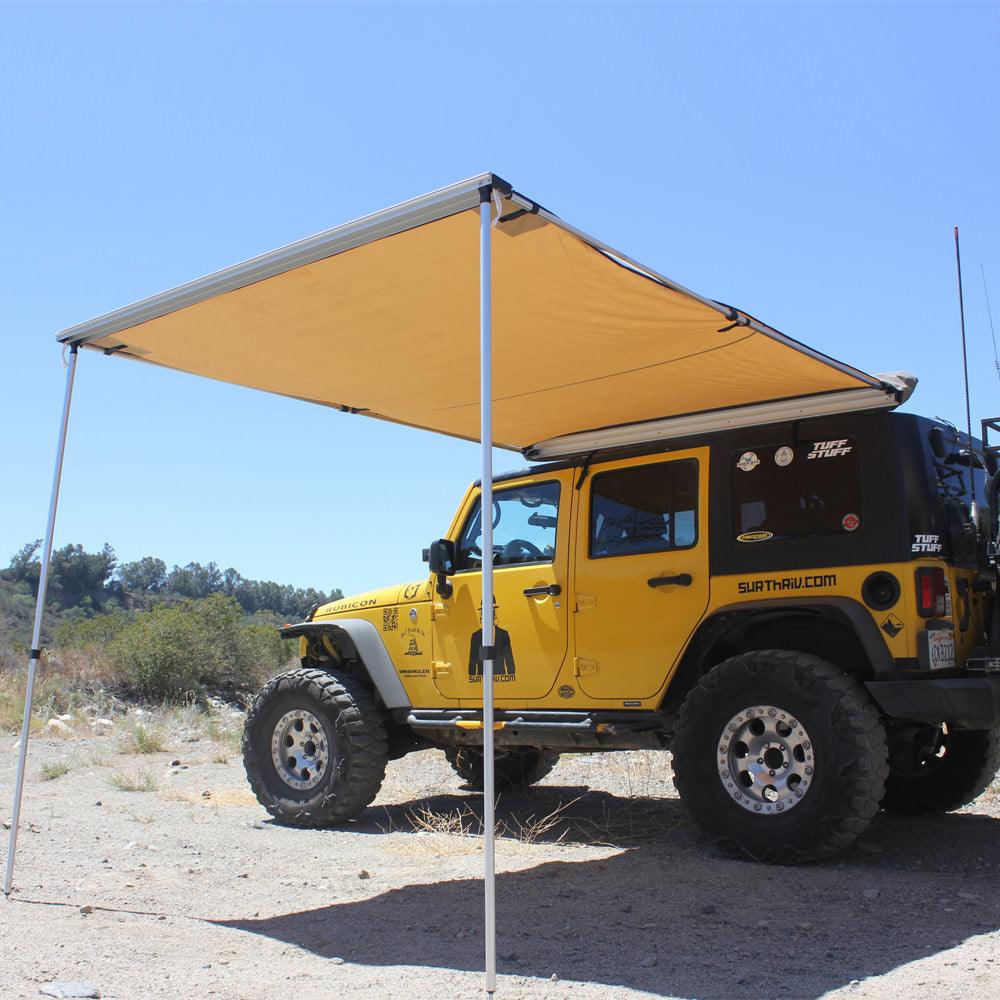
Tuff Stuff 6.5' × 8' straight-pull side awning — best value under $350
Best Mid-Range 180°: OVS HD Nomadic 180 LTE — $449.99
The Overland Vehicle Systems HD Nomadic 180 LTE is the awning for car camping that bridges the gap between a basic side pull and a full 270 batwing. It provides approximately 75 sq. ft. of shade with heavy-duty fabric, an aluminum frame, and a one-person deployment mechanism. The OVS HD Nomadic 180 LTE mounts to any aftermarket roof rack with included hardware and comes with a four-year limited warranty. Add the optional side wall (~$350) for a full car awning with walls when weather turns. This is the best overlanding awning for couples and weekend overlanders who want solid quality without paying for 270-degree coverage they don't need.

OVS HD Nomadic 180 LTE — 75 sq. ft. of shade at $449.99
Best Value 270°: OVS Nomadic 270 — $849.99
The Overland Vehicle Systems 270 awning is the most popular 270 car awning in overlanding. It provides 129 sq. ft. of freestanding coverage with no poles required in normal conditions. The 600D poly-cotton fabric handles sun, rain, wind, and dust. Pivoting aluminum poles deploy for additional support in extreme weather. Available in passenger-side and driver-side configurations, the Overland Vehicle Systems awning comes in multiple variants: the standard Nomadic 270 at $849.99, with walls (~$1,550), and the Lite 270 version (~$585–$650 without walls, ~$1,018 with walls). The Lite 270 provides 80 sq. ft. of coverage at a lower weight and price point — perfect for mid-size rigs where full-size 270 coverage is more than you need.
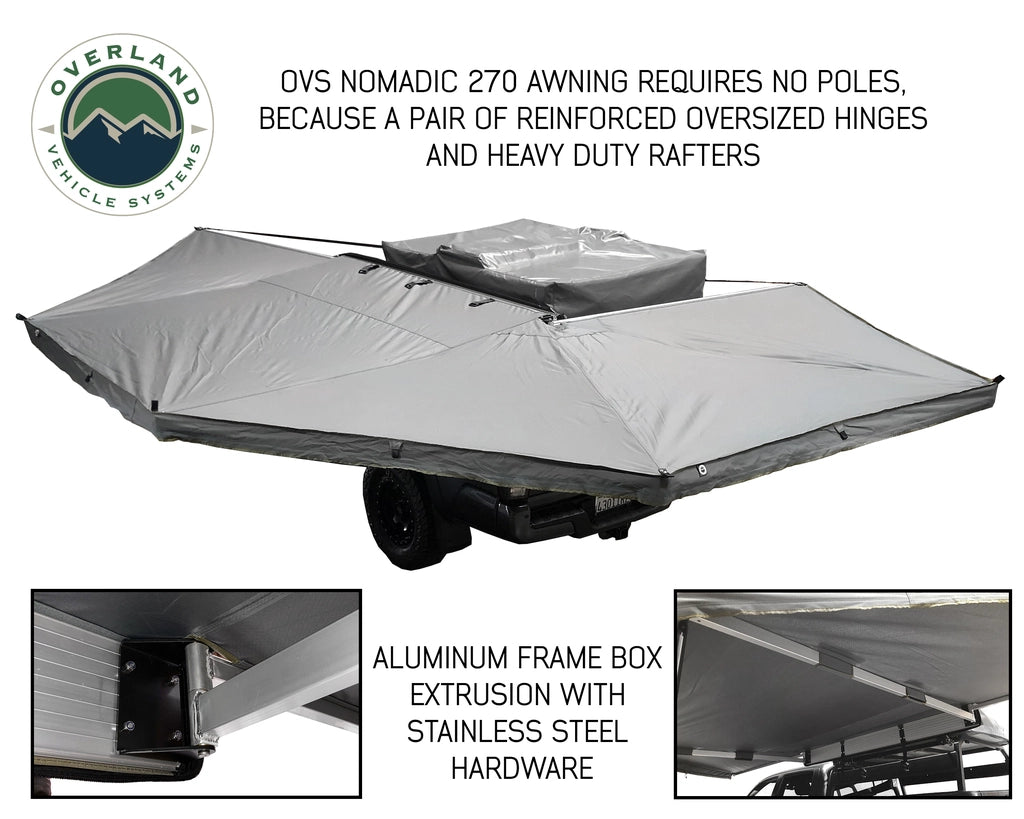
OVS Nomadic 270 — 129 sq. ft. freestanding coverage, no poles required
Best Premium 270°: OVS XD Nomadic 270
The XD Nomadic takes the proven OVS 270 platform and upgrades every component. Aerospace-grade aluminum frame with satin black coating. 125 sq. ft. of coverage. Integrated LED lighting on three support rafters for ambient camp light after sunset. Blackout fabric option. The XD ships with both driver-side and passenger-side mounting brackets included. Lifetime warranty on the frame, four-year warranty on the fabric. This is the best 270 awning for overlanders who deploy daily on extended trips and need gear that lasts seasons without maintenance issues.

OVS XD Nomadic 270 — aerospace-grade aluminum, integrated LEDs, lifetime frame warranty
Best Ultra-Premium: Eezi-Awn Bat 270 — $1,625
Eezi-Awn's Bat 270 is the overland awning that expedition teams choose when failure is not an option. South African engineering, tested on the harshest off-road trails on the continent. The build quality is a step above mass-market options — heavier-duty hinges, thicker fabric, and mounting hardware that survives years of washboard vibration. The BunduAwn by BunduTec ($1,590–$2,170) occupies a similar tier for buyers who want European-engineered premium durability.
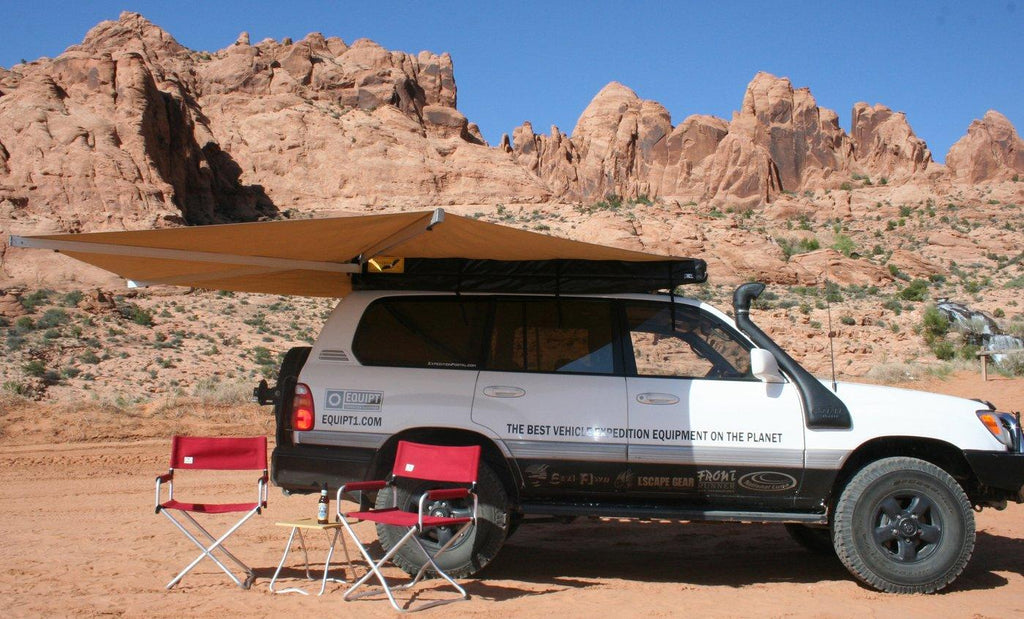
Eezi-Awn Bat 270 — South African expedition-grade engineering at $1,625
Quick Price Guide — Vehicle Awnings at Off Road Tents:
OVS HD Nomadic 90°: $159.99
Tuff Stuff 4.5' × 6': ~$280 | 6.5' × 8': ~$310
OVS HD Nomadic 180 LTE: $449.99
23Zero Peregrine 180 Compact 2.0: $549
OVS Lite 270 (no walls): ~$585–$650
Eezi-Awn Series 1000: $645 | Swift: $740
Tuff Stuff 270 Compact: $770
OVS Nomadic 270 (no walls): $849.99
Rhino-Rack Batwing 270: ~$913
OVS Nomadic Lite 270 (with walls): ~$1,018–$1,050
GoFSR 270 V2: $1,250
OVS Nomadic 270 (with walls): ~$1,550–$1,600
BunduAwn by BunduTec: $1,590–$2,170
Eezi-Awn Bat 270: $1,625
Which Awning Fits Your Vehicle?
Awning choice depends on your vehicle just as much as your camping style. What works on a lifted Tacoma creates problems on a Subaru Outback. Here's how to match an awning for vehicle type.
Tacoma awning: The Tacoma is the most popular overlanding platform in America, and a Tacoma awning setup almost always starts with a cab roof rack (Prinsu, Front Runner, Eezi-Awn K9) or bed rack (Billie Bars, Leitner). Mount a 270 car awning on the cab rack for maximum shade, or a straight-pull truck awning on the bed rack if you're already running an RTT on the cab. OVS Nomadic 270 and Tuff Stuff 270 Compact are the most common fits. Weight matters on Tacomas — their 1,200–1,685 lb payload capacity means every pound of awning counts against gear, passengers, and water. The OVS Lite 270 saves weight while still providing 80 sq. ft.
4Runner awning: The 4Runner's fixed roof rails and available platform racks (Front Runner, Prinsu, Eezi-Awn K9) make it one of the easiest SUVs to mount a 4Runner awning on. The roof sits at a moderate height, so telescoping legs provide good headroom without excessive wind exposure. A 270 or 180 awning paired with a roof top tent is the classic 4Runner overland build. The Rhino-Rack Batwing 270 mounts cleanly on Rhino-Rack crossbar systems popular with 4Runner owners.
Jeep awning: Jeep Wranglers and Gladiators run awnings on either cab racks or bed racks. A Jeep awning needs to account for the Jeep's narrow width and tall roll bar configuration. Straight-pull awnings (6.5' × 8') work well on Wranglers. The Gladiator's longer bed supports a full 270 setup on a bed rack or cab rack. The OVS Nomadic series fits both Jeep platforms with universal brackets.
F150, RAM, Tundra (full-size trucks): Full-size trucks have the payload capacity to handle any awning weight without concern. Their longer roof lines and taller ride height benefit from full-size 270-degree coverage. A truck awning on a full-size pickup paired with a tailgate kitchen is the definitive overlanding camp layout — one wing covers the cooking area, the other covers seating, and the rear section shades the tailgate workspace.
SUV awning (Outback, RAV4, crossovers): Compact SUVs need lightweight awnings that don't overwhelm the vehicle's payload capacity or roof rack rating. A retractable car cover awning in the straight-pull format (20–35 lbs) is the safest choice. The Rhino-Rack Dome or a Tuff Stuff 4.5' × 6' fits without adding excessive weight. Avoid large 270-degree batwing systems on small SUVs — the weight can affect handling, especially on technical off-road sections where center of gravity matters.
Awning Walls, Rooms & Accessories
Most quality vehicle awnings are modular — you start with the base awning and add accessories as your needs evolve. This is the smart way to build a car awning camping setup: learn what you actually need on real trips before spending on add-ons that might sit unused.
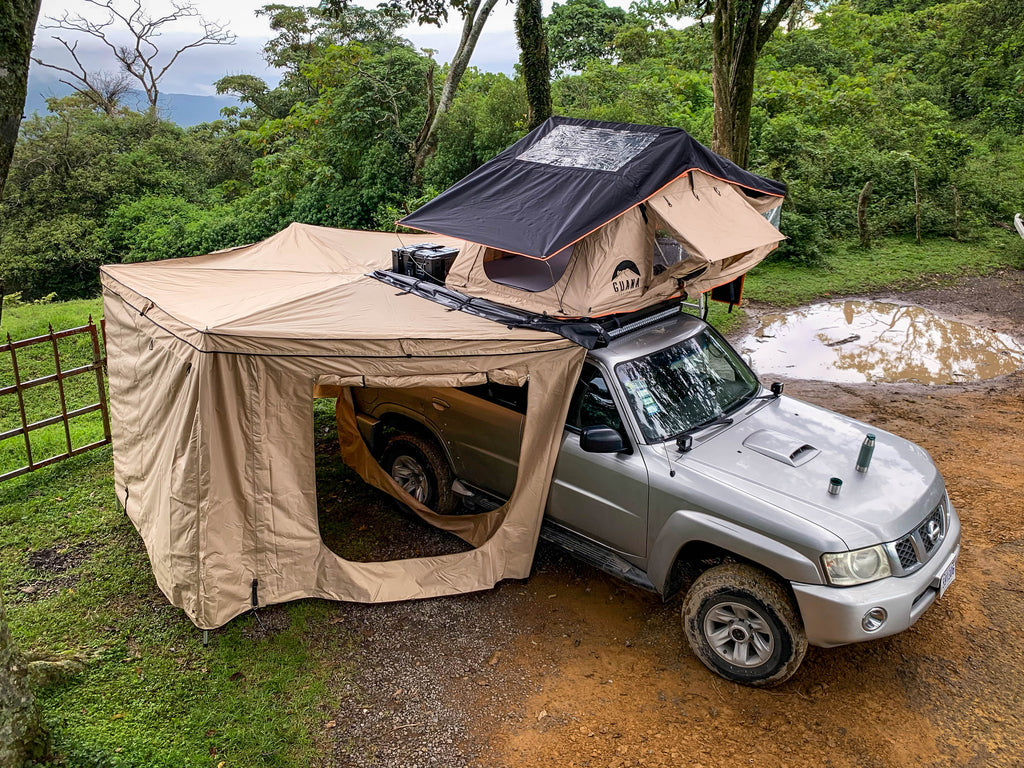
Awning walls convert open shade into an enclosed shelter — add them as needed
Awning with sides (walls): Zip-on or clip-on side walls convert an open car awning with walls into an enclosed shelter. This transforms your awning from a shade canopy into a windbreak, privacy screen, and rain shelter in one step. OVS sells individual walls for the Nomadic 270 (~$200 per wall) as well as complete three-wall sets. Tuff Stuff, Guana Equipment, and Front Runner all offer wall options for their awning lines. A car awning with walls is essential for cold-weather camping, high-wind locations, and anywhere you want privacy at camp.
Awning rooms: Full enclosure rooms attach to the awning frame and create a floor-to-ceiling enclosed space — essentially a ground tent that uses your vehicle's awning as the roof. OVS makes a portable safari tent and privacy room that zip into the Nomadic series. These rooms add sleeping space for additional crew members or create a dedicated gear storage area at camp.
LED lighting: Many modern awnings come with integrated LED lighting or accept aftermarket LED strips. The OVS XD Nomadic 270 includes LEDs on three support rafters. For awnings without built-in lights, a magnetic rechargeable camp light or adhesive LED strip along the awning's leading edge provides hours of ambient light for cooking, reading, and night camp activities. ARB's Touring Awning features an integrated LED strip powered by a standard cigarette plug connection.
Mounting brackets and hardware: Universal awning mount brackets ($50–$100) let you attach any awning to most rack systems. The Front Runner Easy-Out Awning Brackets and Quick Release Mount Kit are two of the most popular. If you plan to remove your awning seasonally (many overlanders do), quick-release brackets save time and prevent wear on your rack's mounting points.
Setup Tips & Maintenance
A well-maintained awning lasts 5–10 years of regular use. A neglected one develops mildew, sagging hinges, and torn fabric within a season. Here's how to get the most life out of your investment.
Deploy with a pitch angle. Tilt your awning 10–15 degrees (one side lower than the other) to prevent water pooling on the fabric during rain. Water pooling is the #1 cause of fabric damage and frame stress. Most awnings have adjustable legs — lower one side slightly and water runs off instead of collecting. Modern awnings from OVS and Rhino-Rack include pitch arms specifically designed to prevent pooling.
Use guy lines in wind. Freestanding 270 awnings are stable in calm conditions, but any wind above 15 mph needs guy lines and stakes for safety. The OVS Nomadic 270 is rated for 25 mph freestanding and 40 mph when fully staked — but those ratings assume proper guy line placement. Carry extra stake and rope kits for exposed camp sites. Close or retract your awning entirely in forecasted severe storms to prevent catastrophic frame damage.
Dry before storing. Never pack a wet awning for more than 24 hours. Mildew grows on damp poly-cotton canvas quickly and creates permanent stains and odor. If you have to pack wet on a rainy morning, open and dry the awning at your next stop or at home before long-term storage. Brush dust and debris from hinges and moving parts after dusty trails. Lubricate hinge points periodically with a dry silicone spray.
Check mounting hardware regularly. Trail vibration loosens bolts over time. After your first 50–100 miles with a new awning, re-check every bolt. After that, inspect mounting hardware at the start of each trip. A loose awning on a highway is a dangerous situation — for you and for other drivers.
Frequently Asked Questions
What is the difference between a 270 awning and a 180 awning?
A 270 degree awning wraps around one side and the rear of your vehicle, providing 80–129 sq. ft. of coverage in a batwing shape. A 180-degree awning extends along one side only, providing 60–85 sq. ft. The 270 creates more outdoor living space and covers the tailgate area, but weighs more and costs more. The 180 is lighter, simpler, and adequate for solo and couples camping. For most overlanders, the 270 is worth the upgrade if your vehicle's payload supports it.
Can I mount a car awning without a roof rack?
Not recommended. A vehicle awning needs a structural mounting point — a roof rack, crossbars, or rain gutter mount — to transfer wind loads safely into the vehicle's roof. Mounting an awning directly to a bare roof with adhesive or suction will fail in wind and can damage your vehicle. If you don't have a roof rack, install one first. We carry racks for virtually every vehicle at Off Road Tents.
Can I run a roof top tent and an awning on the same rack?
Yes — this is one of the most common overlanding setups. The awning typically mounts to one side of the rack while the tent occupies the center or opposite side. Plan carefully to avoid interference: make sure your tent opens on the side opposite the awning case, and verify that the awning's deployed arms don't collide with the tent's ladder. Most overlanders mount the awning on the passenger side and the tent opening on the driver side, or vice versa.
How does a car awning affect fuel economy?
A roof-mounted vehicle awning adds drag and weight, typically reducing fuel economy by 1–3% at highway speeds. Hard-case awnings (like the OVS Nomadic series) create less drag than soft-cover designs. The fuel impact is minimal compared to the drag from a roof top tent or cargo basket. For most overlanders, the camp comfort an awning provides far outweighs the small fuel penalty.
What size awning do I need for car camping?
For a car camping awning that covers one person and a cooking area, a 4.5' × 6' straight-pull (27 sq. ft.) is sufficient. For two people with chairs and a stove, a 6.5' × 8' side awning (52 sq. ft.) or a 180-degree awning (60–85 sq. ft.) works well. For families or groups of four or more, a 270-degree awning (100+ sq. ft.) provides enough room for everyone. Always consider your vehicle's roof rack capacity and payload when sizing up.
Are vehicle awnings waterproof?
Quality car awnings are water resistant to waterproof, depending on fabric and coating. Look for a PU coating rated to at least 2,000mm water column — this handles sustained rain without leaking. Poly-cotton canvas (used in OVS, Eezi-Awn) is naturally more water resistant than basic polyester but takes longer to dry. The weakest points are seams — double-stitched, taped seams are essential for rain protection. No awning is designed for snow loads; clear snow buildup immediately to prevent frame collapse.
How long does a good vehicle awning last?
A well-maintained premium car awning lasts 5–10 years of regular overlanding use. Durability depends on UV exposure (desert rigs degrade fabric faster), storage practices (always dry before long-term storage), and whether you properly stake in wind. Budget awnings may last 2–4 seasons before fabric fading or hinge degradation requires replacement. Investing in quality upfront (OVS, Eezi-Awn, Rhino-Rack) pays back in longevity.
What is the best awning for a Tacoma?
For a Tacoma, the OVS Nomadic Lite 270 (~$585–$650) is the best balance of coverage, weight, and price. It provides 80 sq. ft. of shade without overwhelming the Tacoma's payload capacity. If you want maximum coverage and can handle the weight, the full OVS Nomadic 270 (129 sq. ft.) or Tuff Stuff 270 Compact ($770, 80 sq. ft.) are both popular Tacoma awning choices. For budget builds, the Tuff Stuff 6.5' × 8' side awning ($310) provides solid shade with minimal weight and cost.
Can one person set up a 270 awning alone?
Yes — most modern 270 awnings are designed for solo deployment. The OVS Nomadic 270, Tuff Stuff 270, and Rhino-Rack Batwing 270 all deploy by one person in 3–5 minutes using swing-out arms and self-supporting legs. Practice at home first. In windy conditions, having a second person makes deployment safer and faster, but it's not required in calm weather.
Do I need awning walls?
Not necessarily. Walls are optional and most overlanders start without them. Add walls later if you frequently camp in wind, cold weather, or locations where privacy matters. An awning with sides converts open shade into an enclosed shelter — useful for winter camping, desert dust storms, and crowded campgrounds. OVS sells individual walls for the Nomadic 270 (~$200 each) so you can add one panel at a time as needed.
What is the difference between a metal car awning and a fabric car awning?
A metal car awning uses a hard aluminum case for storage and transport, with fabric panels that deploy from the case. The "metal" refers to the case and frame, not the shade surface — all vehicle awnings use fabric for the canopy. There is no fully solid-metal shade awning designed for vehicles. When people search for a car awning metal solution, they're usually looking for an awning with a durable aluminum frame and hard-case storage, which is exactly what the OVS Nomadic, Eezi-Awn, and Rhino-Rack lines offer.
Can I use a vehicle awning on different vehicles?
Yes. Most retractable car awning systems mount via universal brackets that attach to any roof rack with crossbars or T-slot channels. If you switch vehicles, you may need different brackets for the new rack, but the awning itself transfers. This makes a quality vehicle awning a long-term investment that survives multiple vehicles — buy once, remount as your rig evolves.
Related Guides
📖 Shop All Awnings
OVS, Eezi-Awn, ARB, Rhino-Rack, Tuff Stuff, 23Zero, Front Runner & more — all with free shipping.
📖 180 vs 270 Awning
Side-by-side comparison of coverage, weight, cost, and setup — which design fits your rig and camping style?
📖 How to Mount an Awning
Step-by-step installation guide for mounting a vehicle awning on crossbars, platform racks, and rain gutters.
📖 Best Awning for RTT Setup
How to pair an awning with a roof top tent on the same rack — mounting, spacing, and the best combos.
Find the Right Awning for Your Rig
We carry car awnings, vehicle awnings, and overlanding awnings from every major brand — side pulls, 180s, and 270s for trucks, SUVs, Jeeps, and vans. All with free shipping and expert fitment advice.
📞 844-200-3979 | Free Shipping | Expert Fitment Advice